
The Frustrating Reality of the "Zero Balance" Shock
Let me guess—you bought a shiny new whole-life insurance policy because your agent swore it was the ultimate secret to building massive wealth. But when you ripped open your first annual statement and saw a big, fat zero next to your "Cash Value," your heart probably sank into your stomach. Did you just get scammed? I felt the exact same panic a few years ago. Before you angrily call your agent to cancel the whole thing, let me show you the hidden math behind where your money is actually going (and why you shouldn't panic just yet).
I felt like I had been scammed out of my hard-earned money. My stomach dropped, and I instantly regretted making such a massive financial commitment without understanding how it actually worked.
It is a terrible feeling to think you are making a smart choice for your family, only to feel tricked. Millions of hardworking people face this exact same anxiety every single day. You pay those high premiums month after month, expecting to see a fat savings account growing in the background.
Instead, you look at your annual statement and see a number that makes you want to cry. This confusion creates a massive amount of stress in our daily lives. Husbands and wives end up arguing over whether they should just cancel the policy and cut their losses.
Your 30-Second Policy Survival Guide:
- Zero Cash Value is Normal: Your early payments cover the heavy cost of setting up the massive death benefit. Do not expect savings in the first three years.
- The Company Does Not Steal: Your cash value is just the "living equity" of your death benefit. When you die, your family gets the full promised amount.
- Avoid the "Premium Holiday": Paying your premiums using your dividends will starve your account and kill your long-term compound growth.
- Watch the Loan Interest: If you borrow against your policy and ignore the interest payments, the debt will secretly eat your entire cash value and collapse the contract.
Decoding the Hidden Mechanics of Your Premium Dollars
If you are currently staring at a surprisingly low balance on your insurance statement, take a deep breath. You are likely experiencing exactly what the contract was designed to do, even if nobody bothered to explain it to you. The insurance industry operates on mathematical principles that are often the exact opposite of what regular people expect.
To solve this massive headache, we need to completely erase everything you think you know about traditional banking. A whole life policy is not a savings account, and treating it like one is the fastest way to get frustrated. Let's break down the actual scientific mechanics of where your money goes when you write that premium check.
The Heavy Lifting of the Setup Phase
The absolute biggest misconception in the entire insurance world is the idea of instant cash value. People assume that if they pay $500 a month, they should have $6,000 in cash value by the end of the year. That is completely false, and expecting a one-to-one return will always leave you disappointed.
During the first two to three years of a permanent policy, your account is going through the setup phase. The insurance company takes on a massive amount of financial risk the very second you sign the contract. If you pass away in month two, they have to pay out hundreds of thousands of dollars to your family.
To justify taking on this huge risk, the company fronts a lot of internal expenses in the beginning. Your early premium dollars are paying for the actual cost of insurance, the medical underwriting, and the administrative fees. Because of these heavy upfront costs, there is simply no money left over to drop into your savings bucket.
Think of it just like buying a brand-new house with a standard thirty-year mortgage. During the first few years, almost every single dollar of your monthly payment goes strictly toward the interest. You are not building any real equity in the house, but you still get to live inside it and enjoy the protection it provides.
Quick Math: The Year 1 Setup Trap
- You Pay: $6,000 in premiums for the year.
- Where it goes: About $5,000 pays the insurance company for their risk (if you die tomorrow, they owe your family $500,000). The remaining $1,000 covers agent commissions and admin fees.
- Your Cash Value: $0.
- The Reality: You are buying a massive safety net first, and a savings account second. The cash value engine usually does not start turning a profit until year 7 to 10.
Myth Busting: Does the Company Steal Your Savings When You Die?
This is easily the most terrifying rumor on the internet today, and it stops many people from sleeping at night. You will hear self-proclaimed financial gurus screaming that the insurance company completely steals your accumulated money upon your death. They claim your family only gets the base death benefit, while the greedy corporation pockets your hard-earned cash value.
To clear up this massive misunderstanding, we have to look at how the math actually functions behind the scenes. Your cash value and your base death benefit are not two completely separate pots of money.
The cash value is actually just the present-day equity you hold in the total death benefit. As you pay your premiums over the decades, your cash value slowly rises to match the total face amount. When you finally pass away, the company pays out the total death benefit, which naturally includes the equity you built up.
Saying the company "steals" your cash value is like saying the bank steals your home equity when you sell your house. When you sell, you get the total value of the house, which includes the equity you built. Your family is getting exactly what was promised to them in the contract.
If you feel totally confused about where your premium dollars are actually going, you need to watch this simple breakdown right now.
The Truth About Dividends and Guaranteed Growth
Another massive area of confusion surrounds the concept of dividends and guaranteed returns. Many agents sell these policies by throwing around massive, exciting percentage numbers. They make it sound like you are investing in the stock market but without any of the risks.
In reality, the growth engine inside a permanent policy is incredibly boring, conservative, and slow. The company guarantees a very small, flat interest rate that builds the foundation of your account. On top of that guarantee, participating policies may pay out a yearly dividend based on the company's profits.
However, you must understand that dividends are never legally guaranteed. If the insurance company has a bad financial year, they can absolutely choose to reduce or skip the dividend payment. Relying on an overly optimistic dividend illustration is a guaranteed path to future disappointment.
Pro Tip: I made a huge mistake early on by letting my agent set my dividends to automatically pay my monthly premiums. I thought I was being smart by saving cash out of pocket, but I was actually suffocating the policy. I eventually realized that reinvesting those dividends was the only real way to make the numbers grow effectively.
Dividend Reinvestment: Myth vs. Reality
- The Myth: If I use my dividends to pay my monthly premium, I am getting free insurance!
- The Reality: You are actually starving your policy. By draining the dividends to pay the bill, you stop the compound interest from growing. If you want a fat cash value later, you have to pay the premium out of your own pocket today and let the dividends buy more insurance (PUAs).
The "Paid-Up Additions" Snowball Effect
If you want to actually see your numbers go up over the long term, you need to understand Paid-Up Additions (PUAs). When the company issues a dividend, they will ask you what you want to do with that money. The absolute best choice for long-term growth is using that dividend to buy tiny, mini insurance policies.
These mini policies are completely paid off immediately, meaning they have no ongoing premium costs. Because they are paid off, they immediately add both cash value and death benefit to your overall total. The next year, those new additions will also earn their own dividends, creating a beautiful mathematical snowball.
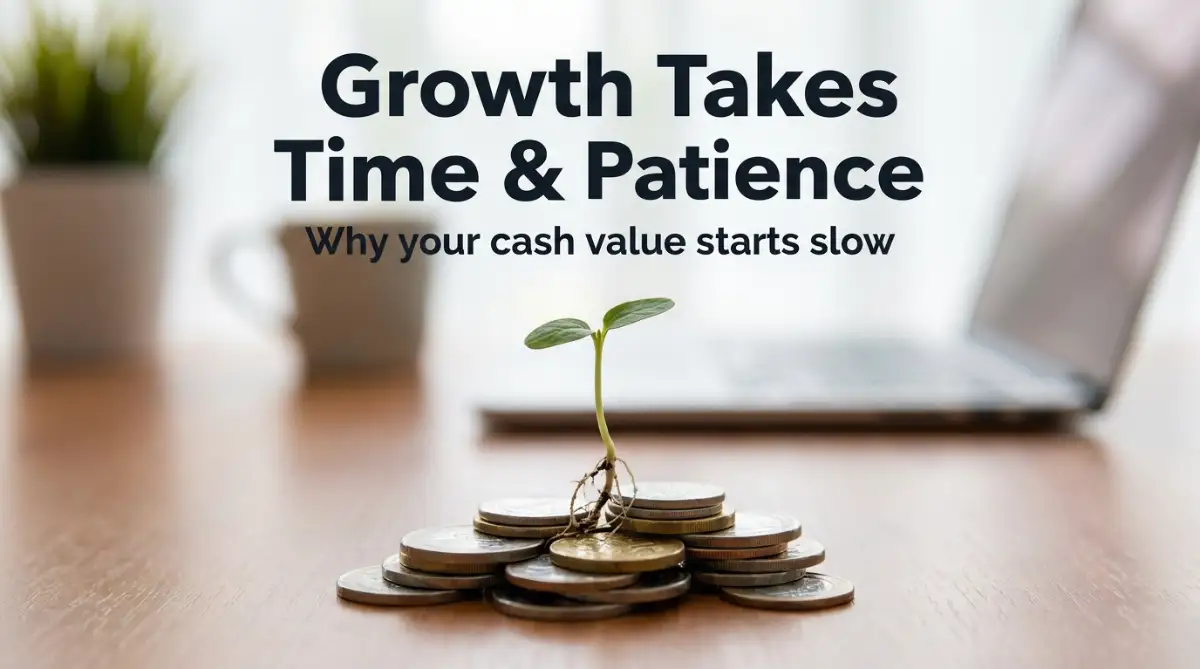
This is exactly how compound interest functions inside the protective shell of an insurance contract. It starts off incredibly slow, almost painfully slow, for the first ten years. But by year fifteen or twenty, the compounding effect takes over, and the growth finally becomes noticeable.
The Danger of Treating Your Policy Like a Checking Account
Because the term "cash value" sounds so accessible, people assume they can just swipe a debit card and use it. This is a very dangerous misconception that can literally destroy your entire financial safety net. Accessing the money inside your contract is not like walking up to a standard ATM.
When you want to use the money, you are usually taking out a loan against the policy, not a direct withdrawal. The insurance company uses your cash value as strict collateral and hands you money from their general fund. Because it is a loan, the company is going to charge you an annual interest rate.
If you take out a $10,000 loan and completely ignore it, that interest will silently compound against you every single year. Eventually, the loan balance could grow so large that it eats up the entire cash value of the policy. If the loan gets bigger than the cash value, the entire policy will collapse and cancel itself.
If it collapses, you will suddenly owe a massive tax bill to the government for the phantom gains you experienced. This is why you must treat a policy loan with the exact same respect as a serious bank loan. You need a clear, structured plan to pay the interest, or you risk losing your family's protection entirely.
Breaking Down the Surrender Value Reality
Let’s say you read all of this and decide that a permanent policy is simply not right for your current lifestyle. You decide you want to cancel the contract and walk away with your accumulated money. This is where many people hit a massive brick wall of frustration because they misunderstand the terminology.
Your statement will show two different numbers: the 'Cash Value' and the 'Surrender Value'. During the first ten to fifteen years of the policy, the surrender value will be significantly lower than the total cash value.
The company applies a strict penalty fee for canceling the contract early, known as a surrender charge. They do this to recoup the massive upfront costs they spent to set up your policy in the first place. If you cancel in year three, you might walk away with absolutely nothing at all.
Understanding this timeline is the absolute key to setting proper financial expectations. A permanent policy is a lifelong commitment, plain and simple. If you cannot confidently commit to paying the premiums for at least fifteen years, it is usually a terrible place to park your money.
By removing the emotional marketing and looking strictly at the math, the product suddenly makes sense. It is not a scam, but it is also not a magical get-rich-quick investment tool. It is a slow, conservative, highly structured legal contract designed to provide long-term stability above everything else.
Mastering Your Permanent Policy for Maximum Growth
Now that we have cleared away the confusing myths from the early years of your contract, it is time to look at the bigger picture. You cannot just buy a permanent policy, throw it in a drawer, and expect it to perform perfectly on its own. It requires active management and a clear understanding of the hidden levers you can pull.
The most successful policyholders treat their insurance like a small business they are quietly building on the side. They do not just pay the base premium; they actively look for ways to accelerate the compounding process. If you want to see your numbers grow much faster, you need to learn about a secret weapon called the Paid-Up Additions rider.
Think of this rider as a special fast-pass lane for your money. Normally, a huge chunk of your standard premium goes toward administrative fees and the actual cost of your death benefit. But when you put extra money into a Paid-Up Additions rider, almost all of those dollars go straight into your cash value bucket.
This creates a massive shortcut for your financial growth. You are essentially buying tiny, fully paid-off slivers of extra insurance that start earning dividends immediately. If you are serious about building a strong personal finance strategy, adding this rider is often the smartest move you can make.

The Hidden Rule of Policy Loans
If you ever plan to borrow against your accumulated funds, you need to understand how the company treats your money while you have a loan. This is an advanced concept, but it completely changes how you access your cash. Insurance companies generally use one of two systems: Direct Recognition or Non-Direct Recognition.
In a Non-Direct Recognition policy, the company continues to pay you dividends on your entire cash value, even the portion you borrowed against. It feels like magic because your money is essentially working in two places at the exact same time. You can use a loan to buy a car, while your full policy balance keeps growing as if you never touched it.
On the other hand, a Direct Recognition policy will adjust your dividend payment downward based on the amount you borrowed. Neither system is inherently bad, but you absolutely must know which one you own before you take out a loan. Understanding these intricate details is a huge part of evaluating life insurance options correctly.
To dig deeper into how these loan structures are regulated to protect consumers, you can check the official guidelines on the National Association of Insurance Commissioners (NAIC) website. They provide unbiased, transparent data on how these contracts legally operate across different states.
Performing an Annual Health Check
Your life is going to change dramatically over the next few decades, and your policy needs to keep up. Just paying your bill every month is simply not enough to ensure you are getting the best results. You need to sit down with your agent once a year for a comprehensive policy review.
During this meeting, you should ask to see a "Current In-Force Illustration." This document is basically a fresh X-ray of your policy, showing exactly how it is performing compared to the original promises. It will reveal if your dividends are lower than expected or if your cash value is slightly behind schedule.
Catching these small issues early gives you the power to fix them before they become massive problems. You might need to adjust your premium payments or change how your dividends are being reinvested. Taking the time to do this yearly review is a cornerstone of protecting family wealth for the next generation.

The Dangerous Traps That Can Destroy Your Cash Value
Even with the best intentions, smart people often fall into hidden traps that completely ruin their insurance strategy. These mistakes do not just hurt a little bit; they can actually wipe out decades of hard work and leave your family unprotected. I want to walk you through the most terrifying pitfalls so you can actively avoid them.
The saddest stories I hear always involve people who thought they were making a clever financial move. They listen to a random internet guru, try to hack their policy, and end up losing everything. Let's look at the specific behaviors that put your money in extreme danger.
The "Premium Holiday" Disaster
One of the biggest selling points of a participating whole life policy is that dividends can eventually pay your monthly premiums. Agents love to pitch the idea that after ten or fifteen years, the policy will magically sustain itself. This concept is called taking a "premium holiday," and it sounds incredibly appealing.
However, people forget that dividends are heavily tied to the overall economy and the company's financial performance. If interest rates drop dramatically, the insurance company will definitely lower their dividend payouts. If you stop paying cash out of pocket and rely purely on those shrinking dividends, your policy will begin to starve.
The company will quietly start eating into your accumulated cash value to cover the missing premium costs. Before you even realize what is happening, your balance will drop to zero, and the policy will completely collapse. Maintaining discipline and paying your premiums out of pocket is the safest way to approach managing household budgets.
The Silent Killer of Unmanaged Loans
We talked earlier about the incredible benefits of borrowing against your policy, but there is a very dark side to this feature. Because the insurance company does not force you to make monthly loan payments, many people just ignore the debt entirely. They borrow fifty thousand dollars to remodel their kitchen and just assume the policy will handle it.
This is the most dangerous financial mistake you can possibly make with permanent insurance. The company is absolutely charging you interest every single year on that borrowed money. If you do not at least pay the yearly interest out of pocket, that interest is added to your total loan balance.
This creates a terrifying snowball effect of compounding debt working against you. The loan will grow larger and larger until it completely suffocates your cash value. If you want to understand how compound interest can work against you, the Consumer Financial Protection Bureau (CFPB) offers excellent resources on managing debt effectively.
The Tax Bomb of a Lapsed Policy
If you let an unmanaged loan completely consume your cash value, the insurance company will terminate the contract. Losing your death benefit is heartbreaking, but the real nightmare happens a few months later. When a policy lapses with an outstanding loan, the government gets involved.
The IRS views that forgiven loan as taxable income, and they will send you a massive tax bill for the phantom gains. Imagine losing your family's financial safety net and then immediately getting hit with a twenty-thousand-dollar tax penalty. This is a very real scenario that ruins families who fail to monitor their loan balances.
You can read the specific tax codes regarding canceled contracts directly on the Internal Revenue Service (IRS) website. It is always better to understand these strict tax rules before you ever request a loan from your provider.
Your Action Plan for Financial Confidence
We have uncovered the honest truth about how these complex financial tools actually operate behind the scenes. You now know that a permanent policy is not a quick-cash ATM or a magical stock market replacement. It is a slow, steady, and incredibly reliable foundation for your long-term security.
Instead of feeling frustrated by the slow early growth, you can now appreciate the heavy lifting the company is doing. You understand the power of Paid-Up Additions and the serious responsibility that comes with policy loans. This knowledge completely shifts you from a confused customer to an empowered policy owner.
Your next step is to grab your latest statement and actually read the numbers with your new perspective. Look at your guaranteed growth, check your dividend history, and make sure your beneficiaries are perfectly updated. Taking these small, intentional steps is the best way to handle reviewing your financial safety net properly.
By removing the unrealistic expectations, you can finally enjoy the true peace of mind this product was built to provide. You are creating a permanent shield around your family that will absolutely never expire as long as you manage it right.
Real Questions People Ask About Whole Life Growth
Can I withdraw my cash value without canceling the policy?
Yes, you can usually take a direct withdrawal up to the exact amount of premiums you have paid into the policy without owing taxes. However, any direct withdrawal will permanently reduce your total death benefit. Most experts recommend taking a policy loan instead of a withdrawal to keep your base contract intact.
Why is my cash balance so much lower than the premiums I paid?
During the first several years, your premium dollars are primarily paying for the actual cost of your death benefit and the company's administrative fees. The cash value takes time to build momentum because it relies on slow, compounding interest. It usually takes ten to fifteen years before your cash value equals the total amount you paid in.
Do I have to pay yearly taxes on the money growing inside?
No, one of the biggest benefits of a permanent policy is the tax-deferred growth. As long as the money stays inside the protective shell of the contract, the IRS does not tax the yearly gains. You only face potential taxes if you cancel the policy or withdraw more money than you originally paid in.
What exactly happens to my cash value when I pass away?
When you die, the insurance company pays your beneficiaries the total face value of the death benefit. The cash value is essentially absorbed because it was just the living equity you held in that final death benefit payout. Your family receives the full promised amount, completely tax-free in most normal situations.
I know exactly how overwhelming it feels to stare at a complicated financial document and wonder if you made a huge mistake. But taking the time to truly learn how your money works completely removes that fear. I want you to look at your policy tonight with fresh eyes and feel incredibly proud of the protective wall you are building for your family.
Disclaimer: The information provided in this article is for educational and informational purposes only and does not constitute financial, legal, tax, or professional insurance advice. Life insurance policies, dividend rates, and tax implications vary greatly depending on your specific contract and location. Always consult with a licensed financial advisor or a certified tax professional before taking out policy loans, changing premium payments, or making any major financial decisions.