The Silent Stress of Unpredictable Electricity Bills
I remember sitting at my kitchen table staring blindly at our latest electricity bill, feeling a heavy knot in my stomach. The numbers simply did not make any sense to me, and my budget was crying out for help. I thought I knew how much power my family was using, but the reality was a complete shock. That single piece of paper made me realize I was flying blind when it came to our daily energy habits. I decided right then and there that I had to figure out exactly where our electricity was going. It took some trial and error, but mapping out our true power consumption changed everything for us.
You probably know exactly what I am talking about right now. The quiet anxiety that creeps in right before you open that envelope or click on that email notification from your utility provider.
It often feels like you are pouring your hard-earned money into an invisible black hole. You turn off the lights, you tell your kids to shut the refrigerator door, yet the bill never seems to go down.
This constant guessing game robs you of your peace of mind on a daily basis. It creates unnecessary arguments at the dinner table over who left the air conditioner running or who is taking too long in the hot shower.
Deep down, you feel powerless because you cannot manage what you cannot measure. You want to take control, maybe even transition to a cleaner home solar energy setup, but the math feels too overwhelming to tackle.
That lingering fear of sizing a solar system incorrectly or buying the wrong equipment keeps you stuck in the same expensive cycle. You are not alone in this fight, and the confusion ends today.
Breaking Down the Great Electricity Illusion
Before we get into the actual numbers, we need to clear up some major misunderstandings about how our homes actually use power. Most of us walk around believing things about electricity that simply are not true. These myths are exactly what keep us trapped in high utility bills month after month.
Let us look at a very common scenario. You might think that shutting off a lightbulb is making a massive difference in your daily energy consumption. While turning off lights is a good habit, a modern LED bulb uses a tiny fraction of power compared to your heating and cooling systems.
Myth: Leaving appliances plugged in but turned off uses zero electricity.
Reality: Modern electronics are notoriously known as "energy vampires." Your smart TV, gaming console, and microwave are constantly pulling a small trickle of power 24 hours a day, just waiting for a remote control signal.
We often focus entirely on the small things while ignoring the heavy hitters in our homes. If you want to accurately measure your energy needs, you have to look at the whole picture. Let us start looking at your home like an energy detective instead of a casual observer.
Becoming Your Own Home Energy Detective
To truly understand your power needs, you have to get familiar with the appliances that run your life. Think of your home as a bustling restaurant. Every single appliance is a customer ordering off a menu, and the electricity is the food they consume.
Some customers only order a small salad, while others demand a massive five-course meal. Your job is to figure out exactly what everyone is eating on an average day. This is the foundation of figuring out your daily energy consumption.
You do not need an advanced degree in electrical engineering to do this. All you need is a piece of paper, a pen, and a willingness to walk around your house. We are going to build a personalized energy map for your specific living situation.
Identifying the Heavy Power Drinkers
The first practical move you can make is walking into your kitchen and utility rooms. These areas are usually where the biggest power consumers live. Your refrigerator, air conditioner, water heater, and electric oven are the heavyweights of your home.
You need to find the specific wattage label on each of these devices. Every appliance legally must have a small silver or white sticker, usually located on the back or hidden just inside the door frame. This sticker is your ultimate cheat sheet for energy calculation.
When you find this sticker, look for a number followed by the letter "W" (which stands for Watts). This number tells you exactly how much power the appliance demands when it is running at full speed.
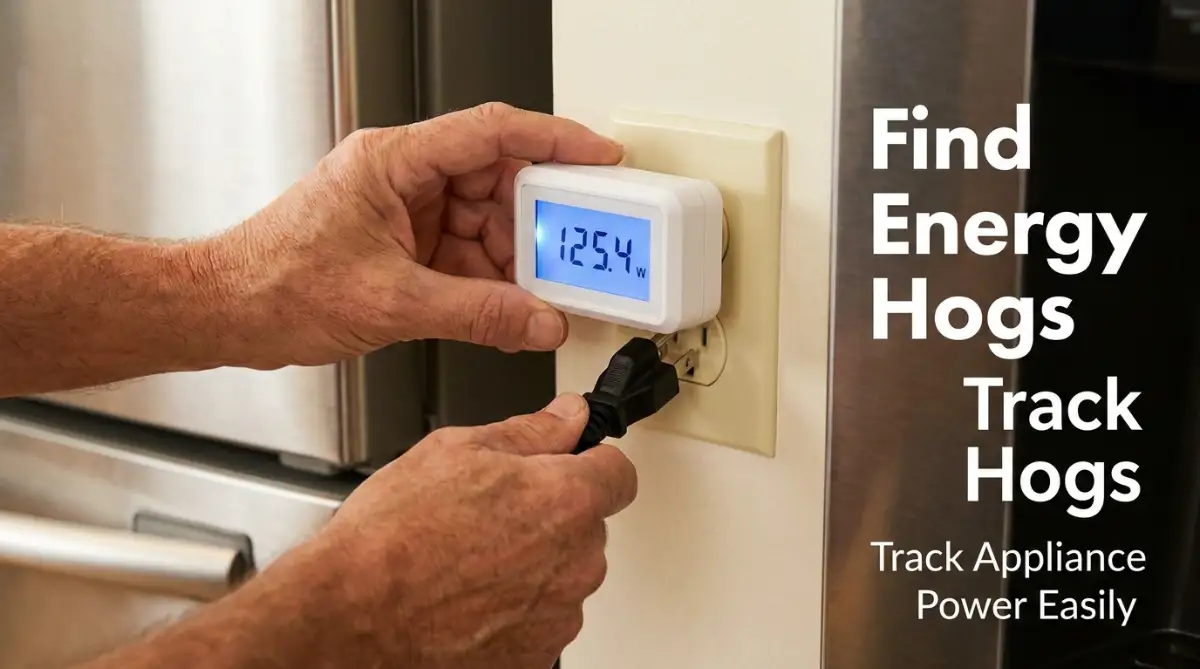
I used to think leaving my desktop computer on sleep mode was saving power, but it was quietly draining my wallet every single month. I finally bought a cheap plug-in energy monitor, and discovering the hidden phantom loads blowing up my bill was a massive eye-opener for me.
Sometimes, the sticker will not show the Watts directly. Instead, it might show Volts (V) and Amps (A). Do not panic if you see this; the math to convert this is incredibly simple. You just multiply the Volts by the Amps to get your total Watts.
Watch this quick breakdown to see exactly how these calculations look in action, saving you hours of frustrating math.
The Time Factor: Why Hours Matter Just as Much as Watts
Knowing the wattage of your television is only half the battle. A 1000-watt microwave sounds like a massive energy hog compared to a 100-watt ceiling fan. However, you have to factor in how long each device actually runs during the day.
You might only use the microwave for five minutes to heat up your lunch. On the other hand, that ceiling fan might spin quietly in your bedroom for ten solid hours while you sleep.
To get your true daily energy consumption, you have to calculate Watt-hours (Wh). This is done by multiplying the appliance's wattage by the number of hours you use it each day.
Let us use a practical example to make this perfectly clear. If you have a 50-watt television and you watch your favorite shows for 4 hours a day, you simply multiply 50 by 4. That equals 200 Watt-hours per day for just your television.
Mapping Out a Fictional Family Routine
To make this completely practical, let us walk through a normal day in a standard household. Imagine waking up at 7:00 AM and turning on the coffee maker. Most coffee makers use around 800 watts, but they only run for about 15 minutes (which is 0.25 of an hour).
That means your morning coffee only costs you about 200 Watt-hours. Next, your family takes showers, meaning the electric water heater has to kick on. Water heaters are massive consumers, often pulling 4000 watts.
If the water heater runs for an accumulated total of two hours throughout the day to keep the tank hot, that is a whopping 8000 Watt-hours. You can quickly see how one appliance absolutely dominates the daily energy budget.
As the afternoon rolls around, the kids come home from school and turn on their gaming computers. A high-end gaming PC can easily draw 400 watts. If they play for three hours, that adds another 1200 Watt-hours to your daily total.
By tracking these daily habits, you start to see patterns. You begin to realize that energy consumption is deeply tied to your family's unique lifestyle, not just the physical size of your house.
The Refrigerator Exception: Understanding Cycling
There is a very specific trick you need to know when calculating your kitchen refrigerator. While it remains plugged in for 24 hours a day, its compressor is not actually running the entire time.
Refrigerators work on cycles. The motor turns on to cool down the inside, and once it hits the target temperature, it shuts off. It only turns back on when the internal temperature starts to rise again.
Because of this cycling, you cannot just multiply a refrigerator's running wattage by 24 hours. If you do, your final calculation will be completely wrong and heavily inflated.
A good rule of thumb is to estimate that a modern refrigerator compressor actively runs for about 8 to 10 hours a day. So, if your fridge is rated at 150 watts, you multiply 150 by 8 hours, giving you 1200 Watt-hours daily.
Dealing with the Phantom Load Sneak Attack
We mentioned energy vampires earlier, but we need to address how to actually measure them for your final total. Devices that sit in "standby" mode can account for up to 10% of a normal family's entire electricity bill.
Your smart home speakers, the clock on your microwave, and the glowing red light on your television are all sipping power. Individually, they are tiny. But when you add up twenty different standby devices across your home, the numbers become significant.
If you want to be incredibly accurate for a future solar installation, you must account for this constant baseline draw. The easiest way to handle this without losing your mind is to add a 10% buffer to your final daily calculation.
If you add up all your active daily usage and it comes to 15,000 Watt-hours, simply add another 1500 Watt-hours to account for the phantom loads and system inefficiencies. This simple buffer ensures you are never left sitting in the dark.
The Seasonal Shift: Summer Highs and Winter Lows
One of the biggest mistakes families make when calculating their energy needs is only looking at a single day in the spring or fall. Your power consumption is rarely a flat line throughout the entire calendar year.
During the hot summer months, your air conditioning unit might be running non-stop. An AC unit can easily push your daily energy consumption through the roof, doubling or even tripling your normal baseline.
Conversely, in the deep winter, you might be running space heaters or an electric furnace. These heating elements pull massive amounts of power. If you plan a solar array based on a mild Tuesday in October, your system will completely fail you during a freezing January night.
To get the most accurate picture possible, you should ideally look at your past utility bills to find your highest month of usage. Divide that highest monthly total by 30 days. This gives you a "worst-case scenario" daily average, ensuring your future energy setup is tough enough to handle peak demands.
Bringing All the Math Together
Once you have walked through every room, noted the watts, and honestly estimated the hours of use, it is time to build your master list. I highly recommend organizing this into a simple spreadsheet or a dedicated notebook.
Create columns for the Appliance Name, Quantity, Rated Watts, and Hours Used Per Day. Then, create a final column for the Total Daily Watt-hours. Multiply across each row, and then sum up the final column at the very bottom.
This final number is your golden ticket. Let us say your grand total comes out to 22,000 Watt-hours per day. To make this number easier to read and discuss with professionals, we convert it into Kilowatt-hours (kWh).
You do this simply by dividing your total by 1000. So, 22,000 Watt-hours becomes 22 kWh per day. This is the exact metric that utility companies use to bill you, and it is the exact number you need to size a reliable solar system.
By taking the time to map this out, you have completely removed the guesswork from your life. You are no longer hoping the bill will be low; you actively know exactly what you are spending and where you can cut back.
You can now look at your family's habits objectively. Maybe you decide to hang-dry laundry instead of using the electric dryer, instantly saving 3 kWh a day. Knowledge truly is power, especially when it comes to managing your home's electricity.
Taking Your Power Tracking to the Next Level
Now that you have mapped out your basic daily habits, it is time to look at the finer details of home energy management. The basic math is a great starting point, but true independence requires a bit more strategic thinking. You want to build a system that works for you, rather than you working for it.
I learned very quickly that maintaining a low energy footprint is not about sacrificing comfort. Instead, it is about making highly calculated choices that run completely in the background. You can easily automate your savings once you understand how modern technology interacts with your home.
One of the smartest upgrades you can make is installing a smart home energy monitor directly into your main electrical panel. These brilliant little devices use machine learning to read the unique electrical signature of every single appliance. They send detailed reports straight to your phone, showing exactly when your AC kicked on or when someone left the oven running.
According to researchers at the Lawrence Berkeley National Laboratory, homes equipped with real-time feedback systems often see immediate reductions in overall power consumption. Seeing your exact usage in real-time creates an instant behavioral shift. You start noticing patterns you never would have caught with a basic pen and paper calculation.
Mastering the Art of Load Shifting
If you want to truly maximize a future solar setup, you need to understand the concept of load shifting. This simply means changing the time of day you run your most power-hungry machines. You do not stop using them; you just move their schedule.
For example, running your electric dryer at 7:00 PM puts a heavy strain on a battery system because the sun has already gone down. If you shift that laundry load to 1:00 PM, your solar panels can power the dryer directly from the sun. This saves your battery storage for the evening when you actually need it for lights and entertainment.
You can easily apply this logic to your dishwasher, pool pump, and electric water heater. Most modern appliances have built-in delay timers specifically designed for this purpose. You simply load the machine, press the delay button, and let the afternoon sun do all the heavy lifting.
If you own an electric car, load shifting becomes even more important. Charging a vehicle demands a massive amount of sustained electricity. By timing your charging sessions perfectly, you can prevent early battery degradation while keeping your utility costs practically nonexistent.
Defeating Phantom Loads Permanently
We touched on energy vampires earlier, but how do you actually stop them without unplugging every cord in your house? The most practical solution is swapping out your standard power strips for smart power strips. These are specifically designed to kill power to secondary devices automatically.
Imagine your home office setup. You have a computer, a printer, two monitors, and desk speakers. A smart power strip uses your main computer as the "control" device. When you shut down the computer, the strip automatically cuts the physical power to the printer, monitors, and speakers.
This simple swap can shave hundreds of unnecessary Watt-hours off your daily total. The U.S. Department of Energy actively recommends smart strips as one of the easiest ways to eliminate standby power waste. You set it up once, and it works tirelessly behind the scenes to protect your energy budget.
Think about how incredibly frustrating it is when your smartwatch randomly dies due to hidden background settings. Your home operates on the exact same logic. Those small background drains seem harmless, but they quietly destroy your overall performance over time.

The Dangerous Traps of Energy Planning
Even with a solid plan, it is incredibly easy to make a few expensive missteps. I have seen homeowners map out everything perfectly, only to hit a massive wall because they missed one specific detail. You need to know exactly what traps to avoid before you spend a single dollar on new equipment.
The biggest mistake people make is completely ignoring "surge watts" or "starting watts." Almost every machine with an electric motor requires a massive spike in power just to turn on. This spike only lasts for a few seconds, but it completely changes how you calculate your needs.
Think about pushing a broken-down car. It takes a huge amount of physical effort to get the heavy car rolling. However, once the wheels are moving, it takes much less effort to keep it going. Your air conditioner and refrigerator work exactly the same way.
The Hidden Threat of Starting Watts
Your central air conditioner might need 3,000 watts to run steadily. However, when the compressor first kicks on, it might demand a massive 9,000-watt surge for exactly three seconds. If your solar inverter is only built to handle 5,000 watts, the system will overload and shut down instantly.
This creates an incredibly frustrating scenario where your lights go dark on the hottest day of the year. To protect yourself, you must always look for the LRA (Locked Rotor Amps) rating on your heavy motor appliances. Converting this number will reveal the true starting surge you need to account for.
When you start replacing older appliances to lower your daily usage, always verify their true efficiency. A bright yellow sticker might promise low numbers, but independent testing often tells a different story. Checking databases like the Energy Star registry ensures you are getting a machine that actually lives up to its low-power claims.
Building on a Broken Foundation
Another heartbreaking mistake is focusing entirely on the electronics while ignoring the physical state of your house. You can spend weeks calculating the perfect electrical map, but it means absolutely nothing if your home cannot safely support the new technology.
Many homeowners rush to buy panels and heavy battery banks without thoroughly inspecting their property first. Installing thousands of pounds of glass and metal on a weak foundation is a recipe for absolute disaster. The hidden risks of mounting panels on an aging residential roof can lead to severe water damage and complete structural failure.
You must treat your energy upgrade as a holistic home improvement project. Fix the physical envelope of your home before you worry about the electricity flowing through it. Sealing drafty windows and adding fresh attic insulation will naturally lower your heating and cooling demands anyway.
The Financing Trap
Finally, the way you pay for your energy independence matters just as much as the equipment you choose. Because these systems require a significant upfront investment, many people fall into terrible financing traps. They sign bad contracts with hidden fees that instantly wipe out any savings they would have made on their utility bill.
If you are planning to borrow money to upgrade your home's energy system, you have to be extremely careful. Securing a bad loan can put your entire property at risk. Learning how to protect your family assets from aggressive loan agreements is just as important as reading a wattage meter.
Some families find success by leveraging the value they have already built into their property. Tapping into a home equity loan despite having a rough credit history is often much safer than signing an unregulated private lease agreement. Always talk to a trusted financial advisor before signing a twenty-year agreement for solar equipment.
Your Action Plan for a Greener Tomorrow
You now possess the exact knowledge needed to take back control of your household electricity. You know how to read the hidden labels, calculate the hours, and sniff out the silent energy vampires hiding in your living room. The mystery of the monthly utility bill is officially solved.
The beauty of this process is that you can start right now, today, without spending any money. Simply grabbing a notebook and walking through your kitchen will reveal opportunities for massive savings. You will start seeing your home not as a confusing drain on your wallet, but as a perfectly manageable system.
Here is your immediate checklist for this weekend:
- Check the wattage sticker on your refrigerator and water heater.
- Walk through your entertainment spaces and unplug three devices you rarely use.
- Locate your main electrical panel and see if there is physical room for a smart monitor upgrade.
- Review your last three utility bills to find your highest season of usage.
By following this exact blueprint, you are building a rock-solid foundation for total energy independence. The National Renewable Energy Laboratory clearly states that an accurate energy audit is the single most important step before any solar installation. You are doing the hard work upfront so you can enjoy the peaceful rewards later.
I know how incredibly overwhelming this entire process can feel at first glance. But I promise you, once you write down those first few numbers, a huge wave of relief will wash over you. My own journey started with a cheap plastic wattage meter, and it completely transformed how my family lives today. You have the power to make this change, and your future self will thank you for taking action today.
Common Questions About Sizing Your Home Power Needs
What is considered a normal daily electricity usage for a family?
While every home is completely different, a standard American household uses roughly 28 to 30 kWh per day. However, this number can easily double if you rely on older, inefficient air conditioning units or electric baseboard heaters during extreme weather. Your specific number depends entirely on your local climate and personal habits.
Do 240-volt appliances use more electricity than 120-volt ones?
Not necessarily. The voltage just determines how the power is delivered, not the total amount consumed. A 3000-watt machine uses exactly 3000 watts, regardless of whether it is plugged into a standard 120V outlet or a heavy-duty 240V plug. You still calculate the daily energy exactly the same way by looking at the total wattage.
How much extra buffer should I add for a solar system?
Most energy professionals recommend adding a 20% to 25% buffer to your final daily calculation. This extra padding accounts for cloudy days, battery inefficiencies, and natural degradation over time. It is always better to slightly oversize your system than to wake up in the middle of the night without power.
Can I just use my monthly utility bill instead of calculating every appliance?
Your monthly bill is a great tool for seeing your grand total, but it does not tell you how or when you use the power. To properly size an independent system, you need to know your peak surge moments and your daily habits. Doing the manual math gives you the exact blueprint needed for a safe and reliable setup.
Disclaimer: The information provided in this article is for educational and informational purposes only and should not be construed as professional electrical, financial, or legal advice. Always consult with a licensed electrician or certified solar installer before making modifications to your home's electrical panel or investing in a solar power system.