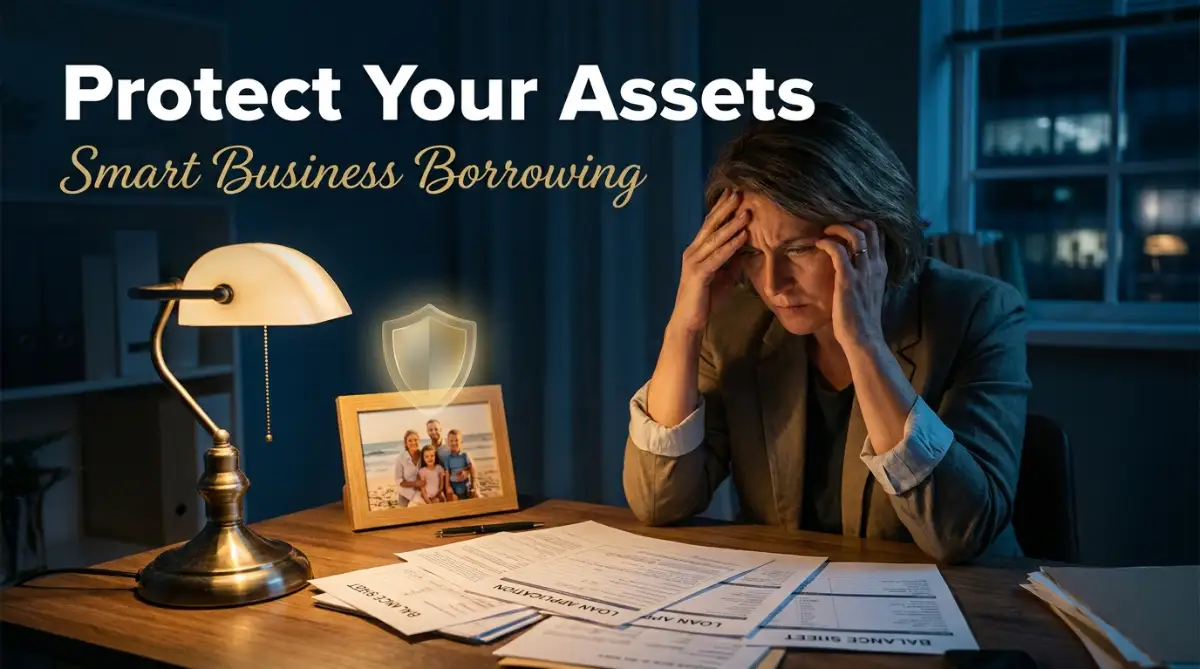
The Silent Midnight Panic of a Business Owner
Starting a business feels amazing until you realize your family's savings might be on the line. When I took out my first round of funding, I was terrified that one bad sales month could literally cost me my home. You do not have to live with that constant knot in your stomach while trying to grow your company. Let me show you exactly how to build an iron wall between your business debts and your private bank accounts so you can sleep peacefully again.
I desperately needed a quick cash injection to keep my small company afloat during a really tough season. An unsecured business loan felt like an absolute lifesaver at the time.
But a terrifying, dark thought kept keeping me awake night after night. What if my business plan fails and the bank decides to come after my family home?
I was literally putting my kids' future and my life savings on the line just to chase my business dreams. That heavy feeling in my chest was something I would never wish upon my worst enemy.
Thousands of everyday founders face this exact same silent nightmare every single day. We pour our blood, sweat, and tears into building something meaningful from scratch.
The reality of managing money for a company is heavily misunderstood by most normal people. When you sign paperwork for borrowing money, the lines between what you own and what the business owes can become very blurry.
Every single time a sales month is slow, that knot in your stomach gets tighter. You start looking at your personal car, your savings account, and your home, wondering if they are truly safe.
This constant anxiety ruins family dinners and turns weekends into stressful worry sessions. You stop being a happy parent or partner because your brain is always calculating worst-case scenarios.
Nobody teaches us these hard lessons in school. We just jump into the deep end, hoping we can swim before the sharks of debt drag us under.
But I am here to tell you that this terrifying situation does not have to be your permanent reality. There are totally legal, highly effective ways to create an iron shield around your family's money.
You can borrow money to grow your company without gambling your child's college fund. It just takes a little bit of smart planning and a few firm boundaries.
Actionable Steps to Protect Your Wealth Today:
- Never sign an unlimited personal guarantee without trying to negotiate a cap.
- Legally separate yourself by forming an LLC or Corporation immediately.
- Open a dedicated business checking account to avoid piercing the corporate veil.
- Use the "Two-Bank System" to keep your personal emergency fund out of reach.
Building an Unbreakable Wall Around Your Wealth
You cannot just cross your fingers and hope your personal money is safe from business mistakes. Hope is simply not a good financial strategy when you are dealing with aggressive lenders and strict banking rules.
We need to build a logical, proven system that separates your private life from your company's risks. This is about making sure that no matter what happens in the market, your family will always have a roof over their heads.
Let us break down exactly how you can set up these safety nets starting today.
Understanding the "Unsecured" Trap
Many founders hear the word "unsecured" and immediately breathe a massive sigh of relief. They assume this simply means the bank will not ask for a house or a car as collateral.
While it is true that you are not directly pledging specific property, there is almost always a hidden catch. Lenders are not in the business of handing out free money without a safety net of their own.
They usually require something called a personal guarantee hidden deep in the paperwork. This simple signature basically destroys the safety barrier between your company and your own wallet.
The Danger of the Personal Guarantee
When you sign a personal guarantee, you are making a legal promise to the lender. You are telling them, "If my company cannot pay this money back, I will pay it from my own pocket."
Suddenly, that unsecured business loan becomes extremely secured by your personal livelihood. If the company goes bankrupt, the lender has the full legal right to sue you personally.
They can go after your personal bank accounts, your investments, and sometimes even your home. This is why you must read every single line of a loan agreement before picking up a pen.
If you must sign a personal guarantee, try to negotiate a "limited guarantee" instead of an unlimited one. A limited guarantee means you are only responsible for a specific percentage of the debt, not the whole thing.
Quick Comparison: Unlimited vs. Limited Guarantee
| Guarantee Type | What It Means For You | Risk Level |
| :--- | :--- | :--- |
| Unlimited | You are 100% responsible for the entire loan amount, plus legal fees, if the business fails. | Extremely High |
| Limited | You are only responsible for a set percentage (like 20%) or a specific fixed dollar amount. | Manageable |

Establishing a Proper Legal Shield
One of the biggest mistakes small business owners make is running their company as a sole proprietorship. When you operate this way, the law sees you and your business as the exact same person.
If your business gets sued or defaults on a payment, you are personally on the hook for everything. To fix this, you must legally register your company as a separate entity, like a Limited Liability Company (LLC) or a Corporation.
This simple legal step creates something called the "corporate veil" in the legal world. This veil acts like an invisible, heavy iron door between your business debts and your private assets.

As long as you follow the rules of running an LLC, lenders usually cannot touch your personal savings if the business fails. Setting up an LLC might cost a little bit of money upfront, but it is the cheapest insurance policy you will ever buy for your peace of mind.
Stop Treating the Business Account Like a Personal ATM
Having an LLC is completely useless if you treat your company bank account like your own personal wallet. This is a very common trap that destroys the legal protection you just worked so hard to build.
If you use your business debit card to buy groceries, pay for a family vacation, or buy personal clothes, you are mixing funds. In the legal world, this dangerous habit is known as "piercing the corporate veil."
If a lender sees that you mix your money, they can tell a judge that your business is just a fake shell. The judge can then easily order you to pay the business debts with your personal savings.
You must open a dedicated business checking account on the very first day you start operating. Every single business expense must come out of this specific account, with zero exceptions.
My Personal Survival Tip:
To stop myself from accidentally mixing funds, I ordered a bright red debit card for my business and kept a standard blue one for my personal checking. This simple color trick completely stopped me from swiping the wrong card at the cash register when buying office supplies!
Watch This Quick Guide on Avoiding Common Money Traps:
If you want to quickly understand how banks actually track your spending and find hidden liabilities, this short video breaks it down perfectly.
The Art of Paying Yourself Correctly
Many new founders just randomly transfer money from the business to their personal account when they need cash. This messy habit creates a nightmare when tax season arrives and breaks the rules of financial separation.
Instead, you need to set up a clean, structured way to pay yourself a regular salary or an owner's draw. Transfer a fixed amount on a specific day of the month, just like a normal paycheck.
When you do this, you create a clear paper trail that proves you are operating a legitimate, separate company. Document every single transfer in your bookkeeping software so there is never any confusion.
I learned the hard way that using my personal credit card for business supplies was a massive mistake. My credit score took a huge hit when my business ran into a slow season, making it impossible to refinance my own house. Always open a dedicated business account from day one, even if it feels like extra paperwork.
Building an Independent Business Credit Profile
If you want to borrow money without risking your family home, your business needs its own credit score. Just like you have a personal credit history, your company can build a completely independent financial reputation.
Most people do not realize that business credit is entirely separate from their personal social security number. You can build this profile by applying for a business identification number from the government.
Once you have this number, start opening accounts with suppliers who report your payments to business credit bureaus. Buy your office supplies, materials, and inventory on net-30 terms and pay them off early every single time.
Over a few months, your business will generate a strong, positive credit history of its own. When banks see a solid business credit score, they are much more willing to offer true business loans without asking for your personal signature.
The Myth vs Reality of Business Borrowing
Let us quickly clear up some major confusion that holds many entrepreneurs back from making safe financial choices.
The Myth: Taking an unsecured loan means absolutely zero risk to me personally.
The Reality: Unless your business is a highly established corporation with great credit, banks almost always sneak a personal guarantee into the fine print.
The Myth: I do not need a business bank account until I start making a lot of profit.
The Reality: You need a business bank account before you make your very first dollar. Mixing a five-dollar coffee expense can legally break your corporate protection.
The Myth: Setting up an LLC completely protects me from all lawsuits and debts.
The Reality: An LLC only protects you if you maintain strict financial boundaries. If you commit fraud or sign away your rights via a personal guarantee, the LLC shield completely disappears.
A Clear Look at Your Liability
Sometimes, seeing the facts side-by-side makes the picture much clearer for busy founders. Here is a simple breakdown of how different choices impact your personal safety.
Securing the Right Type of Insurance
Legal structures and separate bank accounts are amazing shields, but they are not the only tools you need. A smart entrepreneur always adds a layer of professional insurance to catch the unexpected curveballs.
General liability insurance is an absolute must-have for almost any type of company today. If someone gets hurt at your shop or sues you for property damage, this insurance pays the heavy legal bills.
Without this coverage, a massive lawsuit could quickly drain your business accounts to zero. Once the business account is empty, hungry lawyers might try to find a way to attack your private wealth next.
There is also something called "Errors and Omissions" insurance, which protects you if a client claims your service cost them money. Paying a small monthly premium for these policies is a small price to pay to keep your home safe from angry clients.
Navigating Alternative Funding Options
Sometimes, the smartest way to protect your personal money is to completely avoid traditional bank debt altogether. If the bank insists on an aggressive personal guarantee, you should comfortably walk away and look at other options.
Think of business funding like a menu at a restaurant; you do not have to order the first expensive item you see. You can look for small business grants, which is basically free money provided by the government or large corporations.
Grants take a lot of time and effort to apply for, but they never require a personal guarantee or monthly payments. Another great route is looking into local angel investor groups in your city.
Investors give you money in exchange for a small piece of your company's ownership. If the business sadly fails, you do not owe the investor their money back, meaning your personal bank account stays totally safe.
Keeping Your Spouse Out of the Danger Zone
When you are desperately trying to get approved for funding, a banker might suggest adding your spouse as a co-signer. They will tell you that having two incomes on the application will guarantee a much lower interest rate.
This is an incredibly dangerous trap that you should avoid at all costs. The moment your partner signs that paper, their personal income, their private car, and their retirement funds are officially at risk.
If the business crashes, the bank can ruin both of your credit scores at the exact same time. It is always better to accept a slightly higher interest rate alone than to drag your entire household into a risky financial agreement.
Your spouse should remain the financial safe harbor for your family. If your business takes a massive hit, you will desperately need at least one person with a perfect credit score to help the family survive the storm.
The Daily Habits of Protected Founders
Protecting your personal assets is not something you do once and then completely forget about. It requires a series of small, highly disciplined daily habits that keep your financial walls strong.
You must check your business bank statements every single week to catch any unusual activity or unauthorized fees. You should hold regular meetings with a certified accountant, even if you are just a team of one.
Treat your small company with the exact same strict rules as a massive global corporation. Keep physical receipts organized, log your driving miles accurately, and never blur the lines of your budget.
When you build these healthy financial habits, the constant fear of losing everything slowly begins to fade away. You can finally go to sleep at night knowing your family is completely safe, no matter what happens in the crazy world of business.
Next-Level Strategies for Bulletproof Wealth Defense
Setting up an LLC and opening a separate bank account are just the baseline moves for any serious entrepreneur. If you truly want to sleep peacefully at night, you need to think a few steps ahead of the banks.
Long-term financial safety requires building multiple layers of defense around your family's money. Let us explore some highly effective, expert-level strategies that wealthy founders use to stay completely protected.
The Power of the "Two-Bank" System
Most normal people keep their personal checking account, their business account, and their family savings all at the exact same local bank branch. This feels very convenient because you can see all your money on one simple mobile app.
However, this is actually a massive security risk that most bank tellers will never warn you about. Banks have something written in their fine print called the "Right of Offset."
If your business misses a payment on an unsecured loan, the bank can legally reach into your personal savings account at that same bank to take the money.
To prevent this nightmare, you should always use the "Two-Bank System." Keep all of your business checking and business loans at Bank A across town.
Then, keep your family emergency fund, your personal checking, and your mortgage at a completely different financial institution, like Bank B. This simple physical separation creates a massive wall that protects your private cash from sudden business loan freezes.

Leveraging the Holding Company Structure
As your company grows and becomes more successful, you might start buying expensive assets like delivery trucks, heavy machinery, or office buildings. Keeping these expensive assets in the exact same legal entity as your daily operations is a very risky game.
If a vendor or a lender sues your main operating company, all of those expensive trucks and buildings are suddenly at risk. Smart business owners use a strategy called a holding company to divide their risk.
Think of it like a heavy, fireproof vault. You create one company (the holding company) that simply owns the expensive assets, and it does not interact with the public at all.
Then, you create a second company (the operating company) that takes out the unsecured loans, signs the risky contracts, and deals with regular customers. The operating company just rents the equipment from your holding company.
If the operating business ever fails and cannot pay its unsecured debts, the lenders cannot easily touch the valuable assets hidden safely inside the holding company. When you review the official guidelines on choosing a business structure, you will see how separating assets legally minimizes your overall risk.
Conducting Your Own Quarterly Liability Audit
You cannot just build a financial shield and ignore it for the rest of your life. Business rules change, banking policies update, and your own spending habits can easily slip over time.
You need to schedule a strict liability audit on your calendar every single quarter. Sit down with your accountant and look specifically for any places where your personal and professional money might have accidentally crossed paths.
Did you accidentally pay for a personal flight with the corporate credit card? Did you personally co-sign a new software contract because the vendor demanded it?
You must eliminate any hidden habits ruining your credit score before you ever apply for more funding. Fixing these tiny mistakes quickly is the only way to keep your corporate protection perfectly strong.

The Silent Traps That Destroy Financial Boundaries
It is incredibly easy to make a tiny paperwork mistake that completely ruins your legal protection. A single moment of stress or panic can lead you to sign away the safety of your family home.
Let us walk through the most dangerous emotional and financial traps that regularly destroy hard-working business owners. Understanding these pitfalls will help you recognize them before you ever put a pen to paper.
The Desperation Borrowing Trap
When cash flow suddenly stops and payroll is due on Friday, panic takes over your entire brain. This intense fear pushes smart founders to make terrible, rushed decisions just to survive the weekend.
Instead of going to a traditional bank, they turn to fast-cash online lenders who promise immediate funding with zero background checks. These lenders know exactly how desperate you are, and they hide absolutely brutal terms deep inside the contract.
If you are running out of cash, you might easily overlook the warning signs you can't ignore when a fast-cash lender approaches you. They often include broad personal guarantees that secretly put a lien on your private house.
Before you ever agree to fast money, you must know how to spot predatory payday loan contracts before signing them. Taking a bad loan out of sheer desperation is often the final nail in the coffin for a struggling company.
Ignoring the Reality of Interest Structures
Another massive mistake founders make is only looking at the monthly payment amount instead of understanding how the loan actually works. They get approved for an unsecured credit line and start spending without reading the terms.
Many of these business loans are legally allowed to change their pricing based on the current economic market. If you do not understand the mechanics behind fixed vs variable interest rates, you are walking blindfolded into a minefield.
A variable rate means your monthly payment can suddenly double or triple without any warning from the bank.
When that payment spikes, the business might not be able to afford it anymore. Because you likely signed a personal guarantee, that massive new payment immediately becomes your personal problem to solve.
The "Stealth Collateral" Nightmare
We have talked extensively about how unsecured loans are rarely truly unsecured. But some lenders use extremely tricky legal language to grab collateral without ever saying the word out loud.
They might include a small clause called a "Confession of Judgment" in the middle of a fifty-page document. By signing this, you are basically agreeing that if you ever miss a payment, you automatically lose the lawsuit before it even starts.
The lender can take that signed paper directly to a judge and legally freeze your personal bank accounts the very next morning. You will not even get a chance to defend yourself in a courtroom.
You must aggressively question every single legal document before signing it. The legal concept of piercing the corporate veil is something courts take very seriously, and one bad signature can strip your protections away instantly.
Do's and Don'ts for Safe Debt Management
To make these rules a little easier to digest during a busy workday, here is a quick cheat sheet you can reference.
Do This:
- Always negotiate the terms of a personal guarantee to cap your exact dollar amount.
- Keep a highly detailed paper trail of every single penny that moves between you and the company.
- Read the actual Federal Trade Commission rules regarding fair debt collection to know your legal rights as a borrower.
- Maintain a healthy personal emergency fund that the business is never allowed to touch.
Do Not Do This:
- Never use your personal social security number to apply for a business credit card.
- Never let a lender rush you into signing a digital document on your phone without reading it on a computer.
- Never transfer business assets into your personal name just to hide them from angry creditors.
Your Master Action Plan for Financial Peace
Managing money for a growing company is always going to carry some level of stress and uncertainty. However, that stress should never threaten the safety of your family or the roof over your head.
You have the absolute power to control how much risk you personally take on. By building strong legal walls, respecting the two-bank system, and avoiding predatory lenders, you create an unbreakable shield around your private wealth.
If you are already deep in the hole, do not panic and do not ignore the phone calls. You might need a real guide to debt consolidation to help reorganize your liabilities and get back on solid ground.
Take a deep breath and start implementing these boundaries today. Set up that separate bank account tomorrow morning, review your current contracts this weekend, and take your life back from financial fear.
I remember how terrifying my first major business debt felt when I signed the paperwork, constantly wondering if I was putting my own family at risk. My best advice to you is to treat your personal wealth with the exact same fierce protection as your business ideas, because your peace of mind is worth more than any amount of funding.
Honest Answers to Your Biggest Wealth Defense Questions
Can a bank actually take my house for an unsecured business loan?
If you signed a personal guarantee, the answer is unfortunately yes. The loan is unsecured for the business, but your signature makes you personally liable, meaning a judge could eventually put a lien on your private property to satisfy the debt.
Does simply closing my LLC permanently erase my business debts?
No, shutting down your company does not magically make the debt disappear into thin air. If you mixed funds or signed guarantees, creditors will look right past the closed LLC and demand the money directly from your personal bank accounts.
Can I legally transfer my personal savings to my spouse to avoid collectors?
This is an incredibly bad idea known in the legal world as a fraudulent transfer. If a court discovers you hid money just to avoid paying a valid debt, you can face severe legal penalties, and they will pull the money right back anyway.
Where can I report a lender who is using aggressive or illegal tactics?
If a lender is harassing you personally for a business debt, you have strict legal rights that protect your privacy. You can file a formal complaint and review the Consumer Financial Protection Bureau's advice to legally stop aggressive collection calls at your home.
How long does a business bankruptcy affect my personal credit history?
If the business debt was tied to your personal social security number, a bankruptcy can stay on your personal credit report for up to ten years. This is exactly why building a completely independent business credit profile is the smartest thing you can do right now.
Disclaimer: The information provided in this article is for educational and informational purposes only and does not constitute financial, legal, or tax advice. Every business situation is highly unique, and laws vary heavily by location. Please consult with a certified financial advisor or a licensed business attorney before making any major financial decisions or signing legal loan agreements.