The Late-Night Burden of a Heavy Financial Choice
Got a pre-approval letter promising to slash your student loan interest rate? It feels like hitting the jackpot, especially when federal payments eat up almost your whole paycheck. But before you sign the dotted line, you need to know exactly what you are trading away. Leaving the federal system is a strict one-way street. Making the wrong move for a slightly lower rate could wipe out your safety nets overnight. Let's look at what actually happens to your money—and your backup plans—when you ditch the government for a private bank.
My chest felt incredibly tight because I was drowning in massive monthly federal loan payments that were eating up my entire paycheck. I desperately wanted the financial relief that this shiny new private loan was promising me.
But a small, anxious voice in the back of my head kept telling me to read the fine print before signing anything. I was terrified of making a permanent mistake that could completely ruin my financial future.
Every single day, normal people like you and me face this exact same terrifying dilemma. We are forced to choose between the immediate relief of a lower interest rate and the long-term safety of government protection.
📌 Before You Keep Reading: The 30-Second Summary
- Safety First: Federal loans offer Income-Driven Repayment (IDR); private loans do not care about your income drops.
- Forgiveness is Gone: Refinancing to a private lender permanently destroys your chances for Public Service Loan Forgiveness (PSLF).
- The Hybrid Trick: You don't have to move everything. You can refinance just your high-interest loans and keep the rest safe with the government.
- No U-Turns: Moving from federal to private debt is a permanent choice—you can never switch back.
Decoding the Great Student Debt Illusion
Many borrowers jump into private refinancing because the immediate math looks incredibly attractive on paper. If a private lender offers you a 4% rate to replace your 7% government rate, it feels like an absolute no-brainer.
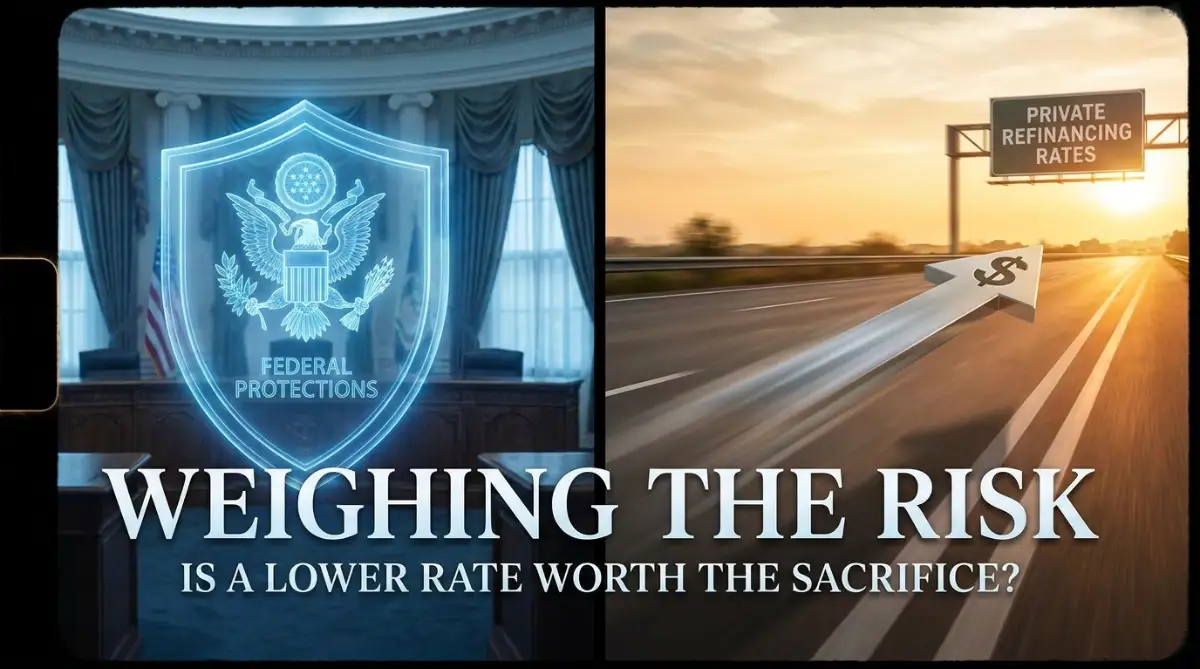
However, looking only at the interest rate is the most dangerous way to evaluate your personal debt situation. You have to understand that the government is not just a lender; they are a massive safety net designed to catch you if you fall.
Private banks, on the other hand, are strictly in the business of making a profit off your monthly payments. Let us break down exactly what you are trading away when you decide to leave the government system behind.
🛑 Quick Check: Myth vs. Fact on Private Lenders
- Myth: If I lose my job, my private lender will pause my payments just like the government does.
- Fact: Most private lenders offer a maximum of 12 months of forbearance for the entire lifespan of the loan, and interest keeps growing every single day.
- Myth: I can always consolidate my private loan back into a federal one later.
- Fact: Once you go private, you can never return to the federal system. The door is permanently locked.
Think of federal loans like buying a sturdy family van that comes with a massive warranty, free roadside assistance, and an airbag system. A private loan is like buying a flashy sports car; it goes much faster, but if you crash, you are entirely on your own.
The Magic of Income-Driven Repayment (IDR)
The absolute biggest safety feature of government debt is the Income-Driven Repayment system. If you suddenly lose your job or take a massive pay cut, the government will actually adjust your monthly bill.
Under an IDR plan, your monthly payment is strictly tied to a percentage of your current discretionary income. If your income drops to zero because of an unexpected layoff, your legal monthly payment drops to exactly zero dollars.
Pro Tip: I learned this the hard way when I impulsively refinanced a small portion of my loans right before my company downsized. I lost my IDR safety net on that specific private loan, and I had to drain my emergency savings just to keep the bank from defaulting me.
Private lenders do not care if your company closes down or if you take a lower-paying job to change careers. When you sign a private contract, you agree to pay that fixed monthly amount regardless of how much money you actually bring home.
Watch this breakdown to understand exactly how to calculate if a lower interest rate is actually worth the risk.
The Dream of Public Service Loan Forgiveness
If you work for the government, a non-profit organization, or in the public health sector, you hold a golden ticket. The Public Service Loan Forgiveness (PSLF) program is designed entirely to reward people who serve their communities.
After making one hundred and twenty qualifying monthly payments, the government completely wipes out your remaining debt balance tax-free. This is a life-changing benefit that can save certain professionals hundreds of thousands of dollars over a decade.
The moment you refinance a government loan into a private bank loan, you permanently destroy your eligibility for PSLF. Private banks do not have forgiveness programs for public servants, teachers, or nurses.
You cannot call the bank five years later and ask them to forgive your debt because you took a job at a local charity. Once the debt becomes private, the path to public service forgiveness is closed forever.
Pausing Your Payments Without the Penalty
Life is wildly unpredictable, and sometimes you just need a temporary break from your financial obligations. The federal system offers incredibly generous deferment and forbearance options for people going through tough times.
If you decide to go back to graduate school, your government loans can be paused automatically without any penalty. If you experience a severe medical emergency, you can request a temporary freeze on your billing cycle.
During certain types of federal deferment, the government even pays the interest that accrues on your subsidized loans. This means your loan balance does not grow while you are busy getting your life back on track.
Private lenders are remarkably less forgiving when it comes to pressing the pause button on your payments. Most private banks might offer a maximum of twelve months of forbearance over the entire lifespan of the loan.
Once you use up those few months of private forbearance, they will demand their money immediately, regardless of your personal situation. Furthermore, private lenders will continue to charge you full interest every single day your account is paused.
The Invisible Trap of Interest Capitalization
When you transition from a federal system to a private system, you need to understand how interest is handled. If you have unpaid interest sitting on your federal loans, it gets tricky when a private bank pays it off.
The private bank buys your total balance, which includes the original amount you borrowed plus any outstanding interest. This new total becomes your brand-new principal balance at the private bank.
This process is called interest capitalization, and it basically means you will now be paying new interest on top of old interest. It is a mathematical snowball effect that can secretly wipe out the savings of that shiny lower interest rate.
Before you agree to switch, you must calculate exactly how much unpaid interest is going to be rolled into your new private contract. Sometimes, the math proves that staying put is actually cheaper in the long run.
How Interest Capitalization Actually Looks on Paper
Here is a simple breakdown of what happens when you move $50,000 in federal loans (with $5,000 in unpaid interest) to a private bank:
| Feature | Staying Federal | Refinancing to Private |
| :--- | :--- | :--- |
| Principal Balance | $50,000 | $55,000 (Old interest becomes new principal) |
| Interest Charged On | Only the original $50,000 | The full $55,000 |
| Long-term Result | Slower balance growth | Paying interest on top of old interest |
The Truth About Permanent Decisions
Here is the most terrifying reality about refinancing student debt that no one talks about at the dinner table. Transitioning from federal to private is a strict, one-way street with no U-turns allowed.
If you refinance with a private bank today and completely hate the experience next year, you cannot go back. The federal government will never "buy back" your private loan and restore your lost safety benefits.
This means you are making a permanent, life-altering decision based on your current financial situation today. But what happens if you get married, have children, or want to start a risky new business five years from now?
Your future self might desperately need the income-driven repayment plans that you permanently threw away today. You have to evaluate this choice not just for the person you are right now, but for the person you might become.
Real-Life Scenarios: Who Should Actually Stay?
Let us look at a practical example to make this complex topic much easier to digest. Imagine Sarah, a social worker making a very modest salary but carrying massive graduate school debt.
Sarah gets an offer in the mail from a private lender promising to lower her interest rate from 7.5% to 5.5%. If Sarah switches, her monthly payment might drop by fifty dollars, which sounds great for her tight budget today.
However, Sarah works for a qualifying non-profit and is currently on track for PSLF in just five more years. If she takes the private loan, she saves fifty dollars a month but loses the chance to have $80,000 forgiven tax-free.
For someone like Sarah, chasing a slightly lower interest rate is a catastrophic financial mistake. The safety net and the massive forgiveness potential at the end of the tunnel are worth far more than a tiny monthly discount.
When Does the Switch Actually Make Sense?
Now, let us look at the other side of the coin to understand when this transition is actually a smart move. Meet David, a highly paid software engineer who just landed a massive promotion at a top tech firm.
David has a very secure job, six months of emergency savings in the bank, and absolutely zero plans to work for the government. His federal loans are sitting at a painful 8% interest rate, and he wants to aggressively pay them off in three years.
For David, the federal safety nets like IDR and PSLF are practically useless because his income is too high to qualify. A private lender offers him a 4.5% interest rate, which will save him thousands of dollars in pure interest over the next three years.
Because David has personal financial stability and a clear aggressive payoff plan, abandoning the federal system is a brilliant move. He does not need the government's airbag because he is driving his financial car extremely safely.
The Co-Signer Complication in Private Lending
The government generally hands out educational loans to eighteen-year-olds without asking for a credit history or a co-signer. They base the loan almost entirely on financial need, trusting that a college degree will lead to future income.
Private banks do not operate on hope or trust; they operate on hard data and strict credit scores. When you apply to move your debt to a private institution, they will pull a hard inquiry on your credit report.
If you do not have a long history of excellent credit and a high salary, the private bank will flatly reject you. To get approved, they will demand that you bring a qualified co-signer to the table, usually a parent or a spouse.
This completely changes the dynamic of your debt, because now you are legally tying someone else's financial future to yours. If you lose your job and miss a payment, the private bank will aggressively attack your co-signer's credit score.

Death and Disability Protections
It is a very dark topic, but we have to talk about what happens if the absolute worst occurs. If you suffer a catastrophic injury that leaves you permanently disabled, the federal government has a built-in safety valve.
Through the Total and Permanent Disability (TPD) discharge program, the government will entirely wipe out your federal debt balance. They recognize that you can no longer work, and they remove the financial burden from you and your family.
If you pass away, federal loans are immediately discharged and do not become a burden on your grieving family. Private lenders are heavily mixed on how they handle these tragic situations.
Some modern private lenders have adopted similar death and disability discharge policies to compete with the government. However, many older or smaller private banks will attempt to collect the debt from your estate or directly from your grieving co-signer.
Evaluating the Customer Service Nightmare
When you leave the federal system, you also leave behind the standardized rules of government loan servicers. Private lenders are massive corporate machines, and their customer service quality can vary wildly from amazing to absolutely terrible.
If your private lender makes a billing error, resolving the issue can take months of frustrating phone calls and written letters. Government servicers are definitely not perfect, but they are highly regulated and answer directly to the Department of Education.
If a federal servicer completely messes up your account, you can file a formal complaint with the Federal Student Aid ombudsman. When a private bank messes up, you often have to hire a lawyer or fight a massive corporate legal department on your own.
You must research the specific reputation of the private bank before you hand over control of your entire financial life to them.
Understanding the Grace Period
When you graduate from college, the federal system gives you a standard six-month grace period before your first payment is due. This allows you time to find a job, secure an apartment, and get your adult life organized.
If you decide to refinance your loans into a private system while you are still in this grace period, you might accidentally trigger immediate repayment. Many private lenders expect you to start making full payments the very next month after the contract is signed.
You must read the specific terms to see if the private bank is willing to honor the remainder of your federal grace period. Losing those precious months of breathing room can completely crash your budget right when you are starting out.
The Impact of Marriage on Your Debt
Your marital status plays a huge role in how your federal and private loans are handled over time. Under the federal system, you can carefully choose how you file your annual taxes to protect your spouse's income.
If you file your taxes as "Married Filing Separately," the government will only look at your specific income when calculating your monthly IDR payment. This strategy legally shields your spouse's salary from being drained by your personal educational debt.
Private banks do not care how you file your taxes with the government at the end of the year. If you fall behind on a private loan, and you live in a community property state, the bank might legally try to seize marital assets.
The transition to a private loan removes your ability to creatively shield your household income using federal tax filing strategies. This is a massive consideration for couples where one person has heavy debt and the other is entirely debt-free.
Master-Level Strategies for a Safe Debt Transition
If you have carefully weighed the risks and still want to leave the government system, you need a bulletproof game plan. You cannot simply click the first shiny online ad that promises to cut your monthly payment in half.
Treat this process like you are negotiating a massive corporate merger, because your financial future is literally on the line. I want to share some incredibly powerful strategies that experts use to beat the banks at their own game.
By taking a highly strategic approach, you can aggressively lower your interest rates while still keeping a strong safety net in place.
The Brilliant "Partial Refinance" Hybrid Method
Most borrowers incorrectly assume they have to move all their government debt over to a private bank at the exact same time. This all-or-nothing mindset is a massive trap that forces you to take on completely unnecessary risk.
Instead, you should seriously consider a hybrid approach known as a partial refinance. You only move the specific federal loans that have incredibly high, punishing interest rates, like Graduate PLUS loans.
You purposely leave your smaller, lower-interest undergraduate loans inside the safe government system. This guarantees that at least a portion of your overall debt is still heavily protected by income-driven repayment options.
If disaster strikes and you lose your job, you will only have to worry about the private portion of your debt. It is the ultimate way to get the best of both worlds without exposing yourself to total financial ruin.
Securing Quotes Without Damaging Your Credit
When you start shopping around for new loan terms, banks will naturally want to check your financial background. However, if five different banks pull your official credit report in one week, your score will drop significantly.
You must only use lenders who offer a pre-qualification process using a "soft credit pull" to show you estimated rates. A soft pull allows you to see their best offers without leaving a negative mark on your permanent credit file.
You want to gather at least three to four different quotes from reputable private banks before making any decisions. Once you compare them, you can even call the banks and use the competing offers to negotiate a better deal.
If you are confused about how everyday actions affect your banking profile, exploring the hidden habits ruining your credit score and how to fix them fast is a great place to start. Building a rock-solid score gives you all the negotiating power.
Choosing Your Rate Type Very Carefully
When you finally get your private loan offers, you will be asked to choose between two very different paths. Lenders will offer you a choice between a fixed interest rate and a variable interest rate.
A variable rate usually starts out extremely low, making your new monthly payment look incredibly cheap on paper. But that rate is tied to the open market, meaning it can suddenly spike upwards if the economy shifts.
If you sign a ten-year variable contract, you might end up paying hundreds of dollars more every month if market rates skyrocket. You need complete clarity on fixed vs variable interest rates and the truth you need to know before signing.
For maximum peace of mind, locking in a fixed rate guarantees your payment will never change, no matter what happens to the global economy.
Building Your Own Private Safety Net
Because you are voluntarily giving up the government's safety nets, you must instantly create your own. Before you officially sign a private refinancing contract, you need cold, hard cash sitting in a secure savings account.
Financial experts aggressively recommend having a minimum of six months of living expenses saved up as an emergency fund. This money acts as your personal "forbearance" if you suddenly get sick or face an unexpected layoff.
If you do not have an emergency fund yet, you have no business giving up your federal loan protections. You can explore independent financial advice on building consumer resilience and managing debt directly through the Consumer Financial Protection Bureau.
Your emergency fund is the only thing that will stop a private lender from defaulting your account when life goes sideways.

Catastrophic Errors That Will Trap Your Finances
Transitioning your debt is like walking through a minefield; one wrong step can blow up your budget for decades. People often make highly emotional decisions based on marketing hype rather than doing the boring, necessary math.
When you rush this process, you usually end up signing away your legal rights to a massive corporation. Let us expose the most dangerous mistakes regular people make so you can easily avoid them.
Falling for Predatory Lending Illusions
The internet is absolutely flooded with shady companies pretending to be legitimate student loan relief programs. They will send you aggressive emails promising to "forgive" your private debt or cut your balance in half overnight.
Legitimate private banks never offer sudden forgiveness, and they definitely do not ask for upfront fees to process a loan application. If a company demands a massive processing fee before they even check your credit, you are walking right into a scam.
You must learn how to read the fine print and spot predatory payday loan contracts before signing anything that looks suspicious. A true refinancing lender makes their money slowly from your monthly interest, not from hidden setup fees.
If the deal feels too magical or they pressure you to sign immediately over the phone, hang up and walk away.
Extending the Timeline to Create Fake Savings
Here is a brilliant psychological trick that lenders use to make you feel like you are saving money. They will offer to drop your monthly payment by two hundred dollars by stretching your loan out to a twenty-year term.
You look at your new monthly budget, feel an instant sense of relief, and immediately sign the contract. But because you are paying the loan for an extra ten years, the bank is secretly collecting thousands of extra dollars in total interest.
You did not actually save money; you just bought yourself a tiny bit of monthly breathing room at a massive overall cost. If your goal is to truly become debt-free, you should always choose the shortest repayment term you can comfortably afford.
For a realistic look at how restructuring works, reading a real guide to debt consolidation and recovery will open your eyes to how lenders manipulate time.
Confusing Federal Consolidation with Private Refinancing
Many frustrated graduates completely mix up two entirely different financial processes and ruin their benefits by accident. Federal consolidation simply means combining multiple government loans into one single government loan to make your billing easier.
When you consolidate through the government, you keep your income-driven repayment plans and your public service forgiveness options intact. Private refinancing means a private bank completely buys your debt, permanently removing you from the federal system.
Thousands of people have accidentally wiped out their forgiveness progress because they clicked on a private bank ad instead of the official government portal. You should always verify your options on the official Federal Student Aid consolidation portal before talking to private banks.
Never let a private sales representative convince you that their product is the exact same thing as a federal program.
Failing to Protect Your Household Wealth
When you bring a co-signer into a private loan agreement, you are putting their personal wealth directly in the line of fire. Let us say you start a small business, run into serious cash flow problems, and default on your new private student loan.
The bank will instantly pivot and aggressively go after your spouse's income or your parent's retirement home. You must structure your finances to create a legal wall between your debt and your family's assets.
Understanding how to protect your personal assets from business loan risks is a highly relevant mindset for student debt as well. You always want to know exactly what a creditor can and cannot touch if the absolute worst-case scenario happens.
Quick Safety Checklist Before Switching:
- Did I calculate my exact payoff date under the new terms?
- Do I fully understand the co-signer release rules?
- Is my job stable enough to survive the next two years without government IDR?
- Have I read the death and disability discharge policy of this specific private bank?
Ignoring the Tax Deduction Rules
Under the current tax laws, you can legally deduct up to a certain amount of student loan interest paid during the year. This deduction directly lowers your taxable income, giving you a slightly better tax refund in the spring.
When you move your debt to a completely private system, you have to ensure the new loan still legally qualifies as an educational loan. If you refinance using a standard personal loan or a home equity line of credit, you might permanently lose that valuable tax write-off.
Always ask the private lender directly if they will issue you the specific official tax form at the end of the year. Losing a tax deduction might not sound like a huge deal, but over a decade, it adds up to thousands of lost dollars.
Your Blueprint for a Stress-Free Financial Future
Managing massive educational debt feels like carrying a heavy backpack up a mountain with no clear peak in sight. The transition to a private bank is a powerful tool, but it is a tool that requires immense respect and careful handling.
You are taking absolute control of your financial destiny, cutting ties with the government, and demanding better interest rates. This choice is incredibly empowering for those who have a solid career path, a growing savings account, and a strict budget.
But if you are currently swimming in uncertainty, there is absolutely no shame in staying within the safety of the federal system. Your peace of mind is always worth more than saving a few percentage points on an interest rate.
Take a step back this weekend, organize your loan documents, and map out exactly where you want to be five years from now. By combining the safety of federal options with the aggressive savings of private refinancing, you can build a customized debt destruction plan.
Pressing Questions About Shifting Your Student Debt
Can I ever transfer my private student loan back to the federal government?
No, this is a permanent one-way street. Once a private bank pays off your federal balance, the government completely closes your file, and you can never reverse the process.
Will applying for a private refinance completely ruin my current credit score?
If you only use "soft credit pulls" to check your estimated rates, your score will not drop at all. However, when you officially sign the final contract, the bank will do a "hard pull," which usually lowers your score temporarily by a few points.
Do any private student lenders offer income-driven repayment plans?
Private lenders do not offer genuine income-driven repayment plans that drop to zero if you lose your job. They expect a fixed monthly payment regardless of your salary, though a few might offer short-term hardship forbearance.
What happens to my private student loan if my co-signer suddenly dies?
It depends entirely on the specific contract you signed with the private bank. Some aggressive lenders have an "auto-default" clause that demands the entire loan balance immediately if the co-signer passes away, so read the fine print carefully.
Is it legally possible to bankrupt a private student loan?
It is incredibly difficult, but not completely impossible. You must prove "undue hardship" in a very complex bankruptcy court proceeding, which most regular people and standard lawyers struggle to successfully win.
I know exactly how suffocating it feels to watch your paycheck disappear into a loan portal every single month. I spent years feeling totally paralyzed by my debt until I finally stopped ignoring the math and took aggressive control of my accounts. You absolutely have the power to organize this mess, negotiate better terms, and reclaim your hard-earned money starting today.
Disclaimer: The information provided in this article is for educational and informational purposes only and does not constitute financial, legal, or tax advice. Always consult with a certified financial planner or a licensed professional before making major decisions regarding student loan refinancing or debt consolidation.