The Heart-Sinking Moment the Screen Goes Dark
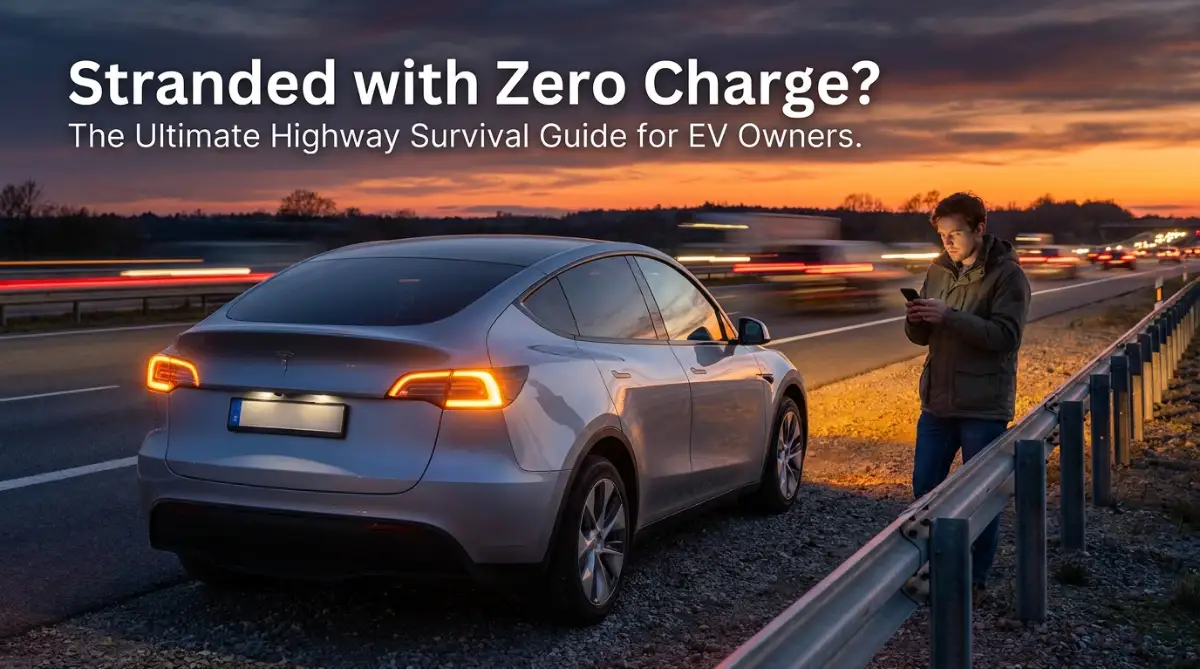
Staring at your dashboard as the battery percentage hits zero while driving on a busy highway is pure nightmare fuel. Your heart races, the car starts slowing down on its own, and you suddenly realize you are about to be stranded. But before you panic, your EV is actually designed to protect you in this exact moment. Let's break down exactly what happens when your electric car dies and the exact steps you need to take to stay safe.
I kept pressing the accelerator, hoping for some hidden reserve power, but the car simply refused to respond normally. It felt like my trusted electric vehicle had suddenly turned into a heavy, rolling brick. My heart pounded in my chest as I realized I was actually going to be stranded on the side of a fast-moving highway.
Every driver dreads this specific scenario. You watch the battery percentage drop faster than expected, and suddenly, you are completely out of power. The mental stress in that moment is completely overwhelming. You start worrying about your safety, the massive semi-trucks zooming past your window, and the potential cost of getting a tow.
Emergency Survival Guide (Key Takeaways):
- When the battery hits zero, your car enters "Turtle Mode," giving you just enough time to pull over safely.
- Turn off your screens, radio, and A/C immediately to stop your smaller 12-volt battery from dying.
- If your 12-volt battery dies, you could get locked inside or outside your car!
- Never let a tow truck drag your EV with the wheels on the ground—it will destroy your electric motors. Always demand a flatbed.
How Your EV Behaves Just Before the Battery Dies
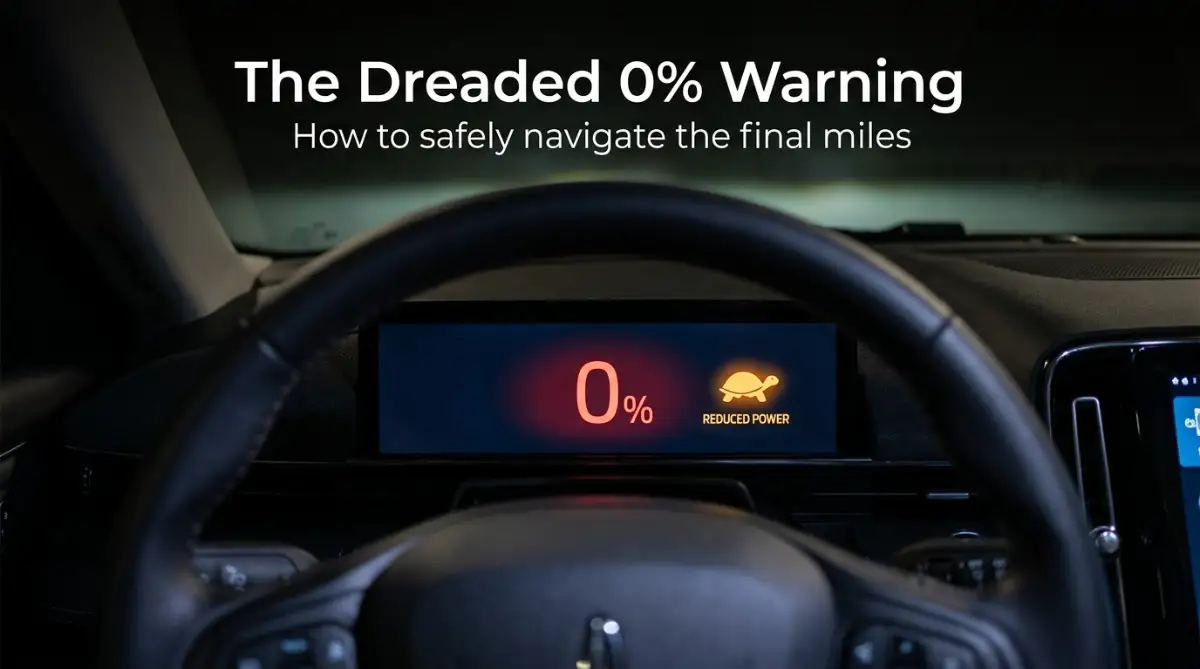
Before your car completely shuts down, it will try to protect you. Electric vehicles do not just turn off instantly like a gas car running out of fuel. Instead, they enter a highly restricted state usually called "Turtle Mode."
During this phase, the car limits top speed, turns off the climate control, and significantly reduces acceleration. The dashboard will likely display a yellow or red turtle icon, letting you know that you only have a few moments left to act. This is the car giving you a final chance to get out of harm's way.
The 60-Second Survival Checklist:
- Step 1: Do not brake hard! Let the car coast naturally to maintain your forward momentum.
- Step 2: Steer toward the right shoulder immediately.
- Step 3: Turn your hazard lights on the second you realize the power is cutting out.
- Step 4: Turn off the A/C, radio, and screens to save your 12-volt battery.
Many drivers make the mistake of trying to push the car further to reach an exit. This is a very dangerous game to play on a fast highway. The moment you feel the vehicle slowing down on its own, your only goal should be finding a safe place to pull over.
Immediate Actions for Total Highway Safety
When the car finally stops moving, your physical safety becomes the absolute priority. The very first thing you must do is turn on your hazard lights. Do not wait even a single second to do this.
You want every approaching driver to clearly see that your vehicle is completely stationary. If you managed to pull over onto the right shoulder, assess the traffic conditions in your rearview mirror. If the traffic is heavy and fast, it is often safer to stay buckled inside the vehicle.
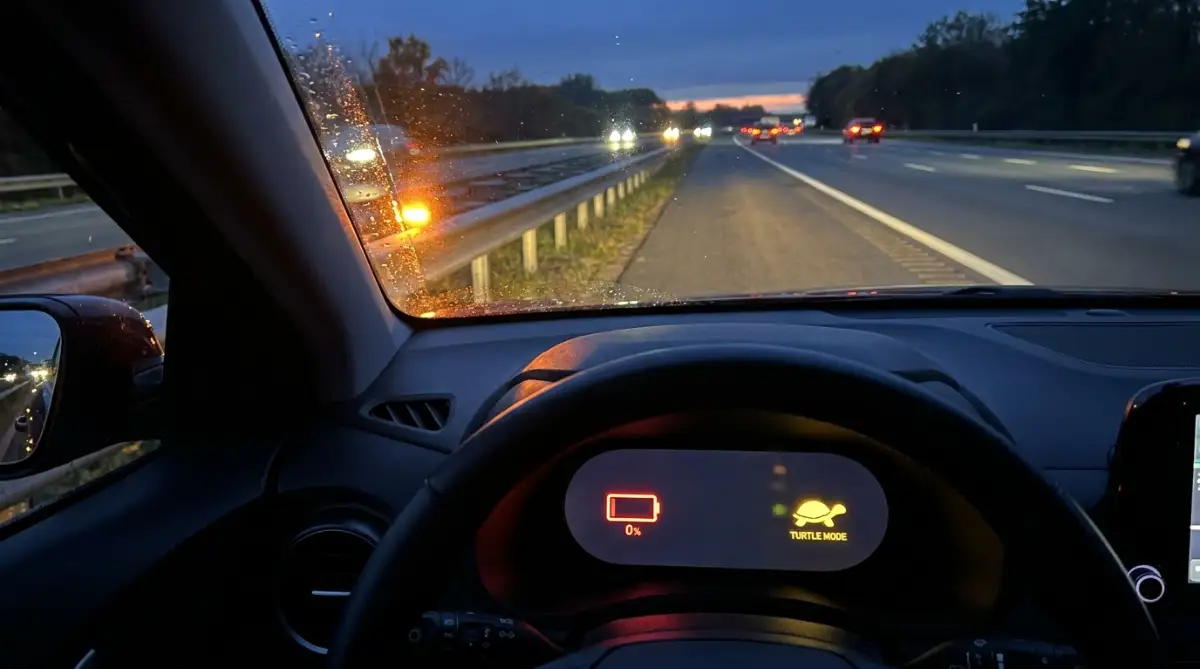
However, if you are safely off the road and there is a guardrail nearby, you should exit the car from the passenger side. Never open your door into the flow of highway traffic. Step over the guardrail and stand well behind your vehicle while you figure out your next steps.
Pro Tip for Highway Stranding
I learned this the hard way: always keep a high-visibility reflective vest in your glovebox. When I was stuck on the highway at dusk, stepping out of my dark grey car made me practically invisible to the passing trucks. Putting on a cheap yellow vest immediately made me feel much safer while I waited for the tow truck.
Understanding the Hidden Battery Problem
Here is something most people completely forget about when their main EV battery dies. Your car actually has a smaller, traditional 12-volt battery running the electronics. This small battery powers your hazard lights, electric doors, windows, and the digital display.
When the main high-voltage battery reaches zero, it stops sending power to the 12-volt system. If you sit on the side of the road for hours with your hazard lights flashing, this smaller battery will eventually die too. If that happens, you might actually get locked inside or outside of your own car.
The Bold Move You Need to Make Right Now
To preserve your electronic functions, turn off the radio, interior lights, and screen displays immediately. Leave only your hazard lights running to stay visible.
Who to Contact When You Have Zero Range
Once you are physically safe, it is time to call for professional help. Your first thought might be to call a family member, but they cannot bring you a can of electricity. You need specialized roadside assistance that understands electric vehicles.
Many auto insurance companies and EV manufacturers offer dedicated roadside support for this exact situation. Check your phone app for your car brand, as many of them have an SOS button built right into the interface. Pressing this button often sends your exact GPS location directly to the rescue dispatch team.
If you do not have an active warranty or app subscription, you will need to call an independent towing service. You must specifically tell the dispatcher that you are driving an electric vehicle. Not all tow trucks are equipped to handle the heavy weight and specific towing requirements of a modern EV.
Mobile Charging Services vs. Traditional Towing
Depending on where you live, you might have access to a mobile EV charging service. These incredible companies drive a van equipped with a high-capacity generator or battery pack directly to your location. They plug into your car on the side of the road and give you just enough juice to reach the nearest charging station.
This option is often much faster and safer than putting your car on a tow truck. Unfortunately, mobile charging is mostly available only in major metropolitan areas right now. If you are stranded on a rural highway, a flatbed tow truck is likely your only realistic option.
Comparing Your Emergency Rescue Options
The Absolute Rule of Towing an Electric Car
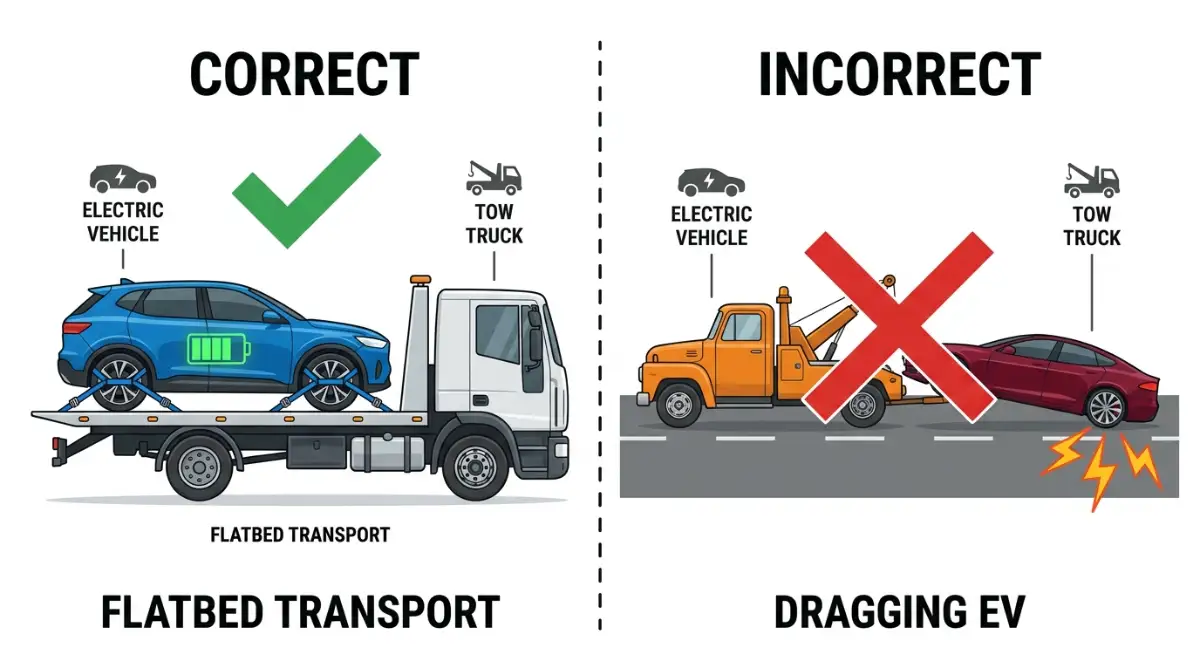
If a tow truck arrives to pick you up, you must pay close attention to the equipment they are using. You can never, under any circumstances, drag an electric car with its wheels on the ground.
Traditional gas cars can often be pulled by lifting the front wheels and letting the back wheels roll. If you do this to an electric vehicle, the spinning wheels will generate electricity and send it back into the dead system. This can easily fry your car's complex electric motors and cause thousands of dollars in permanent damage.
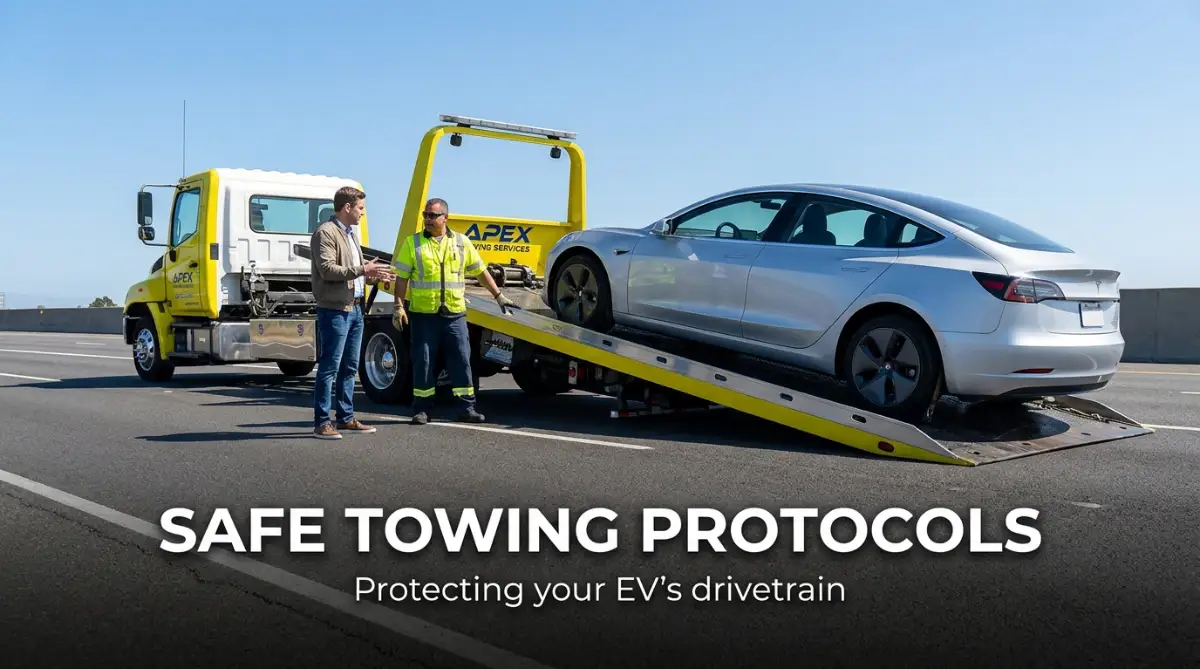
Always insist on a flatbed tow truck where all four wheels are completely lifted off the ground. If the dispatcher sends a traditional wheel-lift truck, you must refuse the service and demand a flatbed. It is much better to wait an extra hour than to destroy your entire drivetrain.
Know Your Tow Trucks (Never Get This Wrong!)
- Flatbed Truck: YES. All four wheels are off the ground. This is the only safe way to move an EV.
- Wheel-Lift Truck (Two wheels down): NO. Dragging an EV forces the electric motors to spin, generating power that will permanently fry your computer system. Send this truck away immediately.
Myth vs Reality: Pushing Your Dead Car
The Myth: If you are only a few hundred yards away from a charging station, you can just put the car in neutral and push it.
The Reality: Modern electric cars weigh significantly more than gas cars because of the massive battery packs. Most of them weigh well over 4,000 pounds. Pushing a dead EV on a highway shoulder is physically exhausting and incredibly dangerous. Furthermore, many EVs completely lock their parking brakes when the battery dies, making it physically impossible to push them anyway.
Managing the Extreme Weight of an EV
Because electric cars are so heavy, tow truck operators must use specific tie-down points to secure the vehicle. Do not let a rushed operator hook chains around the suspension components of your car. If the chains are placed incorrectly, they can puncture the battery pack located directly under the floorboards.
A punctured battery pack is a massive fire hazard. Politely but firmly ask the driver to use soft straps looped through the wheels. If you have the owner's manual in your glovebox or on your phone, look up the exact towing procedures for your specific model and show them to the driver.
Dealing with the Emotional Toll of Range Anxiety
Sitting in a dead car on a loud highway gives you a lot of time to think. You will likely feel a strong sense of embarrassment and frustration. Range anxiety is a very real psychological burden that many new EV owners experience.
You might start kicking yourself for not stopping at that charger you passed 40 miles ago. You might blame the car's navigation system for giving you an incorrect range estimate. It is completely normal to feel upset, but you must stay calm to manage the logistics of getting home.
Remind yourself that even people driving gas cars run out of fuel sometimes. This is just a temporary inconvenience, not a complete disaster. Take deep breaths, drink some water if you have it, and focus entirely on communicating with the tow truck dispatcher.
What Happens When You Finally Reach the Charger
When the flatbed truck eventually drops you off at a charging station, your ordeal is not quite over. Because your 12-volt battery has likely drained while you were waiting, the car might not recognize the charging cable right away. The main screen might stay black even after you plug it in.
If this happens, you will need a portable jump starter or a pair of jumper cables. You have to jump-start the small 12-volt battery first, just like you would in a regular gas car. Once the 12-volt battery wakes up, it will turn on the car's computers, which will then allow the main battery to accept the charge from the station.
Building a Foolproof Backup Plan
After you survive this highly stressful highway event, you will want to make sure it never happens again. The best way to prevent running out of charge is to fundamentally change how you view your battery meter. Stop treating zero percent as your actual destination.
Start treating 15 percent as your new absolute zero. Whenever your battery drops to 20 percent, you should already be actively navigating to the nearest reliable charging station. Weather conditions, strong headwinds, and steep highway hills can eat up your remaining range much faster than the computer predicts.
You should also download multiple charging network applications to your smartphone. Do not rely solely on your car's built-in map, because it might not show recently built stations or chargers that are currently broken. Having apps like PlugShare or A Better Routeplanner gives you real-time data from other drivers.
The Realities of Highway Topography
Many drivers do not realize how much the shape of the road impacts their electric range. Driving up a long, steady mountain incline requires a massive amount of energy. If your navigation system says you will reach the top with 5 percent remaining, you are cutting it dangerously close.
On the flip side, going down a steep hill will actually add energy back into your battery through regenerative braking. However, you cannot depend on downhill stretches to save you if you miscalculate the initial climb. Always build a large buffer into your travel plans when dealing with unfamiliar highway routes.
Keeping Your Family Calm in a Crisis
If you have passengers, especially young children, your reaction will dictate how they feel. If you panic and start yelling at the dashboard, they will become terrified. Keep your voice steady and explain the situation to them in very simple terms.
Tell them the car just needs a quick nap and that a big truck is coming to give it a ride. Keep them entertained with games on a tablet or a smartphone to distract them from the loud noises outside. The calmer you remain, the faster the time will pass while you wait for rescue.
Mastering the Road: Pro-Level Strategies for Uninterrupted EV Travel
Surviving a dead battery on the side of a busy interstate is an experience that changes how you drive forever. Once you get back home safely, you naturally start wondering how to prevent this from ever happening again. The good news is that you can easily take control of your driving habits and outsmart your dashboard computer.
One of the most effective secrets among experienced electric vehicle owners is understanding the hidden impact of weather. Your car's predicted range is highly sensitive to the outside temperature. Driving in freezing winter weather forces your battery to work overtime just to keep itself warm.
To maximize your efficiency, you should always pre-condition your vehicle while it is still plugged into your home charger. This simple habit pulls energy directly from your house instead of draining your car's precious reserves. The U.S. Department of Energy explains how extreme temperatures impact electric ranges, noting that cold weather can heavily reduce your driving distance.
Similarly, relying entirely on your car's built-in map is a habit you need to break today. Factory navigation systems often fail to account for unexpected headwinds or sudden elevation changes. Instead, professionals use dynamic third-party routing apps that calculate exactly how much energy you will burn going up a steep mountain pass.
The Hidden Connection Between Speed and Energy Loss
Many new drivers do not realize how aggressively high speeds drain an electric battery. When you push your car past 70 miles per hour, aerodynamic drag becomes your biggest enemy. Simply slowing down by just five or ten miles per hour can suddenly add miles of unexpected range to your display.
If you ever notice your percentage dropping too fast, tuck yourself safely behind a large semi-truck in the slow lane. Keeping a safe distance while drafting behind a massive vehicle cuts through the wind resistance. This small adjustment takes a massive load off your electric motors and helps you reach the next exit safely.
Understanding your vehicle's mechanics is just as important as knowing what really causes electric vehicle battery degradation and how to stop it. When you take care of the battery cells properly, they maintain their maximum capacity for much longer. This translates directly to more reliable highway miles when you need them most.
Managing Your Internal Power Consumption
Another fantastic trick is getting comfortable with your heated seats instead of blasting the cabin heater. Heating the entire interior air volume of a car requires a huge amount of electricity. Your heated seats and steering wheel use a tiny fraction of that energy while keeping your body perfectly warm.
Think about how you manage your everyday electronics. It is very similar to figuring out why your smartwatch keeps dying halfway through the day. Adjusting a few hidden settings, like screen brightness or climate control limits, can drastically extend your daily usage.
You also need to master the art of regenerative braking. Most modern EVs allow you to adjust how aggressively the car slows down when you lift your foot off the pedal. Setting this to the highest level ensures that every single drop of kinetic energy is captured and sent right back into your battery pack.
The Dangerous Traps Drivers Fall Into When the Screen Goes Dark
Panic makes us do incredibly foolish things, especially when we are sitting on the shoulder of a loud highway. The absolute biggest mistake drivers make is ignoring the initial warning signs their car gives them. When your vehicle enters reduced power mode, it is practically screaming at you to pull over immediately.
Some drivers try to game the system and force the car to crawl along the shoulder toward an upcoming exit. This is a terrifying risk that puts you right in the path of distracted drivers who drift out of their lanes. Just like ignoring the silent warning signs of fake remote job offers, ignoring your dashboard warnings always leads to disaster.
The moment you feel your acceleration artificially limited, your only job is to find a flat, safe patch of grass or shoulder. Do not risk your life for the convenience of being a few hundred feet closer to a gas station.
The Financial Nightmare of Improper Towing
As we discussed earlier, calling the wrong type of tow truck is a catastrophic error. I cannot stress enough how easily a traditional wheel-lift tow truck can destroy your expensive drivetrain. The electric motors in your car are permanently attached to the wheels, meaning they spin whenever the car is moving.
If a tow truck drags your car down the highway, those spinning motors will generate a massive surge of electricity with nowhere to go. This easily fries the internal computer systems and ruins the motors entirely. Replacing an entire EV drivetrain is an absolute financial nightmare that most warranties will refuse to cover due to user error.
If you recently figured out how to get approved for your first auto loan to buy this beautiful car, the last thing you want is a ruined motor. You must protect this investment by fiercely advocating for a flatbed tow truck. According to safety guidelines published by the American Automobile Association (AAA) regarding electric vehicles, flatbed transport is the only universally accepted method for disabled EVs.
Letting the Auxiliary Battery Die
Another heartbreaking mistake is sitting in the stranded car with the radio, headlights, and climate control running. Drivers do this to stay comfortable while waiting an hour for the tow truck to arrive. They forget that all these features run off the tiny 12-volt battery located under the hood.
Once the main battery dies, it stops recharging this small 12-volt system. If you drain this secondary battery, the car's computer completely shuts down. Your electronic doors will not open, your windows will freeze in place, and you might get locked inside your own vehicle.
This also creates a massive headache for the tow truck operator. If the 12-volt battery is dead, they cannot put the car into "Tow Mode" or release the electronic parking brake. They will have to drag your locked, immobile tires onto the flatbed, risking even more damage to your tires and suspension.
Failing to Plan for Charging Station Realities
Many stranded drivers actually caused their own problem by trusting a single charging station on their route. They pull up with two percent battery, only to find the charger is broken, blocked, or completely powered off. This leaves them entirely stranded in a parking lot with absolutely no backup plan.
You must always have a "Plan B" charger mapped out within a comfortable driving distance. If your primary stop fails, you need enough juice left to easily reach the next location. Planning for these infrastructure failures is just as important as knowing how to protect your personal assets from unexpected business risks.
It is also smart to keep a Level 1 charging cable in your trunk at all times. This is the simple cable that plugs into a standard household wall outlet. While it charges incredibly slowly, it can be an absolute lifesaver if you can slowly limp to a friendly business or a nearby campground.
Your Road Ahead: Turning a Stressful Event into a Learning Moment
Getting stranded on the highway without power feels like a horrible failure in the moment. However, it is actually a powerful learning experience that transforms you into a much smarter, more capable driver. You now understand exactly how your car behaves when it is pushed to its absolute limits.
You have learned how to communicate effectively with tow truck dispatchers to protect your vehicle. You know the exact signs of a dying battery and why preserving your 12-volt system is your ultimate priority. Most importantly, you realize that range anxiety is completely curable with just a little bit of proactive planning.
Building a reliable home charging setup gives you peace of mind every single morning. Just make sure you understand the structural requirements of your house first, much like evaluating the unspoken risks of installing solar panels. Starting your day with a full "tank" eliminates ninety percent of the stress associated with electric driving.
A Personal Thought Before You Go
I used to grip the steering wheel in total panic every time my battery dropped below thirty percent. Now, I treat my dashboard gauge like a gentle suggestion rather than a ticking time bomb. The moment I stopped trusting the built-in map blindly and started using dedicated route planners, my daily driving became incredibly peaceful.
Real Questions from Anxious EV Drivers
Can a mobile power bank charge my electric car on the road?
Standard portable power banks meant for laptops or camping cannot charge an electric vehicle. You would need a specialized, heavy-duty mobile EV charger, which is usually only carried by dedicated commercial roadside assistance vans.
Does insurance cover towing an EV to a charging station?
Yes, most modern auto insurance policies with roadside assistance include towing for a dead electric vehicle. However, they usually cap the towing distance, so you will be taken to the absolute nearest compatible public charging station.
How long does a 12-volt battery last when the main battery is dead?
If you turn off the radio, screens, and headlights, a healthy 12-volt battery can keep your hazard lights flashing for a few hours. If you leave the climate control fans running, the battery might die in less than thirty minutes.
Will my electric car lock me inside if it loses all power?
Most electric vehicles have a manual, mechanical door release hidden on the door panel specifically for this emergency. You should check your owner's manual today to locate this physical lever before you ever actually need it.
Is it safe to charge my car in the rain after getting towed?
Absolutely. Electric vehicle charging ports and heavy-duty cables are completely weatherproof and designed with intense safety interlocks. The Institute of Electrical and Electronics Engineers (IEEE) confirms that the system will only transfer electricity once a secure, waterproof handshake is verified by the car's computer.
Disclaimer: The information provided in this article is for educational and informational purposes only. Automotive safety protocols and towing procedures vary heavily by vehicle make and model. Always consult your specific owner's manual and rely on certified professional roadside assistance when dealing with a stranded vehicle.